Modular Retail Unit Cost vs Lease: UK ROI Analysis
TL;DR
Purchasing a modular unit often yields a higher long-term ROI for UK businesses compared to leasing due to asset ownership and the ability to resell. While leasing preserves initial capital, Adacon’s P600 modular system offers faster lead times and lower lifetime costs for permanent or semi-permanent retail sites. Businesses should weigh the tax benefits of capital allowances against the flexibility of short-term rental agreements.
The Retail Reality: Flexibility vs. Asset Ownership
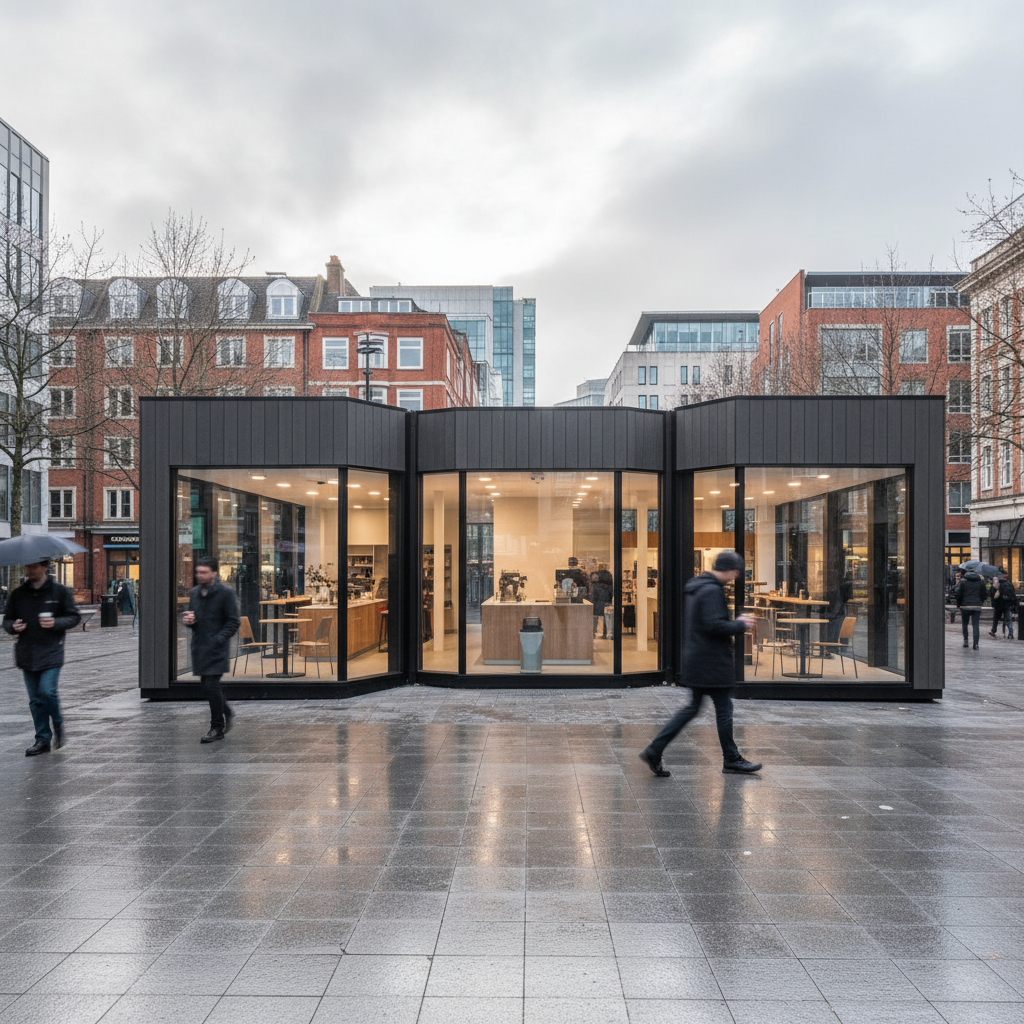
The traditional UK high street is undergoing a structural shift. For retailers, hospitality operators, and brand owners, the choice of physical premises is no longer limited to long-term commercial leases with onerous repair obligations. The rise of the modular retail unit has introduced a third way: high-specification, relocatable buildings that offer the permanence of a traditional build with the agility of a portable asset. When calculating the modular retail unit cost, businesses must weigh the immediate capital expenditure against the long-term operational savings of a high-performance building system.
For many years, the market for portable commercial space was dominated by shipping container conversions. However, modern retailers are increasingly moving away from these constraints. Adacon is a UK modular buildings supplier, not a container reseller. We supply purpose-built steel-framed systems using insulated sandwich panels (P300 through P700 series). Unlike containers, which are fixed in width and difficult to insulate effectively without sacrificing internal space, the Adacon system is designed from the ground up for human occupancy. This makes it a scalable retail asset rather than a temporary fix. Whether you are launching a flagship pop-up or a permanent regional shop, understanding the distinction between operational expenditure (leasing) and capital expenditure (purchasing) is central to your ROI analysis.
The Real Cost of Purchasing a Modular Retail Unit
When purchasing a modular building, the upfront cost covers the core structural and functional elements. At Adacon, our standard specification includes a galvanised steel chassis, insulated walls, floor, and roof, an entrance door, LED lighting, power sockets, and a consumer unit. However, a retail unit is rarely "standard." To create a space that drives sales, retailers typically invest in specific upgrades such as large-format glazing, bespoke cladding, and internal partitions.
The P600 modular retail unit price is determined by the final configuration. A single Adacon P600 module has an external footprint of 12.98 m² and an approximate usable internal area of 11.4 m². For a basic retail shell, prices are generated through our free P600 configurator, which provides an instant estimate based on your choice of windows and doors. Beyond the unit itself, buyers must budget for three critical external factors:
- Groundworks and Base Preparation: A level, prepared base is essential. Depending on the site, this could range from a simple concrete pad to more complex screw piles. Costs for this are project-specific and are the customer's responsibility.
- Transport and Logistics: delivery information across UK mainland and Northern Ireland is quoted separately per site. This ensures you only pay the actual cost of haulage and hiab offloading for your specific location.
- Utility Connections: Final electrical connection to a consumer unit and any required drainage for kitchenettes or WCs must be handled by local contractors.
By opting for a P600 or a multi-module configuration, such as an L-shape or a two-storey block, retailers can create a bespoke environment for a fraction of the cost of a traditional brick-and-mortar extension or a long-term leasehold fit-out.
When Does Leasing Make Sense for UK Retailers?
Leasing a retail space—whether it is a traditional shopfront or a rented modular unit—is often viewed as a way to preserve liquidity. For a startup brand, commercial modular building finance options through leasing keeps capital free for stock, marketing, and staff. This operational expenditure (OpEx) model can be tax-efficient for some business structures, as lease payments are often fully deductible as a business expense.
However, leasing has significant drawbacks in the modular sector. Most lease fleets consist of generic "off-the-shelf" units. If your brand requires specific aesthetics—such as cedar cladding, floor-to-ceiling glass, or specific internal layouts—leasing usually falls short. Furthermore, long-term leasing is often described as "dead money." After five years of rental payments, the retailer has zero equity in the building. In contrast, an owned Adacon unit remains a tangible asset on the balance sheet. For businesses planning to operate in a location for more than 24 to 36 months, the cumulative cost of leasing often exceeds the total purchase price of a high-specification P600 unit.
ROI Analysis: The P600 as a Tangible Business Asset
One of the primary drivers for retail space expansion cost UK analysis is the relocatability of the asset. If a traditional shop location fails, the retailer is stuck with a lease and a sunk cost in the fit-out. If a modular site underperforms, the building can be disconnected and moved to a higher-footfall location. This "portable equity" significantly de-risks the investment.
The secondary market for high-quality Modular buildings is robust. Because Adacon units are built with galvanised steel frames and high-grade insulation (not timber frames that can rot or containers that can rust), they retain a high modular shop resale value. A unit used as a coffee shop for three years can be sold and repurposed as a garden office, a site welfare unit, or a security cabin.
To calculate the break-even point, retailers should compare the monthly lease cost of a similar square-meterage shop against the total purchase and installation cost of a modular unit. Typically, once a unit has been in operation for three years, the cost-per-month of ownership drops significantly below any equivalent commercial rent, especially when the eventual resale value is factored back into the ROI calculation.
Tax and Capital Allowances for Modular Buildings
The modular building tax benefits in the UK can be substantial, but they require careful navigation. Modular units are often classified as "plant and machinery" rather than "buildings" for tax purposes, depending on their use and degree of permanence. This classification is vital because it allows businesses to claim the Annual Investment Allowance (AIA).
- Annual Investment Allowance (AIA): This allows businesses to deduct the full value of qualifying plant and machinery items from their profits before tax, up to a limit (currently £1 million per year).
- Capital Allowances: Elements of the build—such as electrical systems, plumbing, and air conditioning—often qualify for integral feature allowances.
- Business Rates: Generally, business rates apply to any structure used for commercial purposes. However, some modular units on "meanwhile use" sites or small-scale garden-based businesses may qualify for Small Business Rate Relief.
Note: Adacon provides high-quality buildings but does not provide tax advice. We strongly recommend consulting a qualified accountant to understand how VAT and capital allowances apply to your specific retail project.
Planning Permission and Building Regulations
A common misconception is that modular buildings do not require planning permission because they are "temporary." In the UK, any structure that is on-site for more than 28 days or exceeds certain size thresholds generally requires planning approval. For retail unit capital expenditure, planning should be factored into the timeline from the outset.
Local authorities will look at the aesthetic impact of the building, its usage, and its impact on traffic and the surrounding environment. Because the Adacon system is aesthetically versatile—allowing for various cladding options like anthracite steel, timber, or composite—it is often easier to gain approval than it would be for a standard shipping container. When designing modular buildings for retail, you must also consider Building Regulations, particularly regarding fire safety, accessibility (DAA), and energy performance if the building is over 50 m² or intended for long-term permanent use. The responsibility for securing these permissions and ensuring drainage connections are compliant lies with the customer, though our technical sheets can support the application process.
Operational Savings: Energy and Maintenance
Traditional high-street shops are often located in older buildings with poor thermal performance, leading to high utility bills. Adacon units utilize high-density insulation (available in P300 to P700 thicknesses), which creates a thermally efficient envelope. This results in significantly lower heating and cooling costs—a vital consideration given current UK energy prices.
Maintenance is another area where modular excels. The galvanised steel chassis and high-quality external finishes require far less upkeep than traditional masonry or timber structures. While a standard high-street lease might include a "full repairing and insuring" (FRI) clause that makes the tenant responsible for roof repairs and structural maintenance, an Adacon owner has full control over a low-maintenance asset. Standard inclusions like LED lighting and modern consumer units ensure the building is energy-efficient from day one, further reducing the total cost of ownership compared to older, inefficient leased premises.
Designing for Revenue: The P600 configurator Advantage
In retail, every square centimetre must work for its living. The approximate usable internal area of 11.4 m² for a single P600 module is designed to be highly functional. By using our free P600 configurator, retailers can experiment with different layouts to maximise floor space and customer flow.
"The ability to visualize a retail space in 3D, choosing the exact placement of glazing to catch the sun or highlight product displays, allows for a revenue-first design approach that traditional leasing simply cannot match."
For larger operations, the system’s modularity is a major advantage. You can start with a single unit and, as the business grows, add modules side-by-side or in runs to increase the footprint. Multiple units can be joined with open internal spans to create a seamless showroom or café area. This scalability means your modular retail unit cost grows only when your revenue supports it. From a standalone garden salon to a 12-module clubhouse or retail complex, the Adacon system provides a professional, insulated, and durable foundation for any UK business looking to move away from the uncertainties of the leasehold market.
Design yours online — free
You can lay out a retail & hospitality project yourself in a few minutes with the free Adacon P600 configurator: arrange the modules in 3D, pick your windows, doors and cladding colours wall by wall, and see an estimated price straight away. There is no obligation and no salesperson — save the design and we will pick it up from there.
Prefer to talk it through? Request a free quote and we will come back with a specification and price for your project.
Cost breakdown
| Module Type | External Length | External Footprint | Approx. Usable Internal Area |
|---|---|---|---|
| P300 | 2.9m | 6.38 m² | 5.4 m² |
| P400 | 3.9m | 8.58 m² | 7.4 m² |
| P500 | 4.9m | 10.78 m² | 9.4 m² |
| P600 | 5.9m | 12.98 m² | 11.4 m² |
| P700 | 6.9m | 15.18 m² | 13.4 m² |
At a glance
| Feature | Purchasing (Adacon) | Leasing (Rental Fleet) |
|---|---|---|
| Ownership | Full business asset; resaleable. | Third-party owned; no equity built. |
| Customisation | Full choice of cladding, glazing, layout. | Standardised 'box' with limited changes. |
| Monthly Cost | Zero (excluding finance repayments). | Fixed monthly rental fee. |
| Lead Time | Weeks (Stock units available). | Immediate (subject to availability). |
| Long-term ROI | High (Asset appreciation/utility). | Negative (Total cost of rental). |
Pros
- • Full control over retail branding and store layout
- • Significant tax advantages via Capital Allowances
- • Relocatable asset that moves with footfall trends
- • Eliminates long-term rental overheads
- • Higher build quality and insulation compared to standard hire units
Cons
- • Requires upfront capital expenditure
- • Responsibility for site preparation and groundworks
- • Planning permission management is required
- • Depreciation must be managed on the balance sheet
Frequently asked questions
Written by Adacon
Adacon UK designs, manufactures and delivers bespoke modular buildings across the UK for residential, commercial, education, hospitality, leisure and specialist applications. Buildings are designed around the space and use required: several standard module sizes are available, modules are joined side by side or stacked to form larger buildings, and bespoke configurations are considered where a project needs them — from garden rooms and offices to homes, classrooms, clubhouses, cafés, welfare facilities and two-storey buildings.