Modular Office Climate Control Options: AC vs Electric Heating
TL;DR
For multi-module offices, dual-function air conditioning (ASHP) offers superior energy efficiency and summer cooling compared to standard electric panel heaters. While the upfront cost is higher, the reduced long-term running costs and improved staff productivity during heatwaves provide a faster ROI for commercial sites. Adacon's P600 system supports both configurations, with pre-installed electrics as standard.
When selecting modular office climate control options, the choice between traditional electric heating and modern air conditioning (AC) systems is one of the most significant factors affecting both operational costs and occupant comfort. In the UK, where seasonal temperatures vary from sub-zero winters to summer heatwaves exceeding 30°C, a building's thermal management system must be versatile enough to handle both extremes. For commercial buyers and homeowners alike, understanding how the Adacon P600 modular system manages internal temperatures is the first step toward creating a productive, year-round workspace.
Understanding Modular Thermal Performance
The efficiency of any climate control system depends entirely on the building's thermal envelope. Adacon’s Adacon P600 system is engineered with high-density insulated wall, floor, and roof panels that act as a barrier against external temperature fluctuations. Unlike older temporary cabins, which often suffered from significant heat loss, these modern modules are designed to retain warmth in winter and reject solar gain in summer.
In smaller configurations, such as a single garden office or a 3.0m x 2.4m security lodge, the internal volume is easily managed. However, as modules are combined into larger multi-module offices or modular classrooms, the thermal dynamics change. Large open-plan spaces require sophisticated airflow management to prevent "dead zones" where air becomes stagnant.
Internal heat gain is another critical factor. In a busy commercial office, the combined heat output from servers, high-end workstations, and a high headcount can raise the internal temperature by several degrees. This makes the insulation’s role dual-purpose: it prevents heat from escaping when it is cold, but it also necessitates a cooling strategy to manage the heat generated by the occupants and equipment themselves. The UK's high humidity levels also mean that thermal performance isn't just about temperature; it’s about managing moisture to prevent condensation within the structure.
Standard Electric Heating: Pros and Cons
For many site welfare units and temporary site offices, standard electric panel heaters remain the default choice. The primary driver for this is low capital expenditure (CAPEX). A high-quality 2kW electric heater is inexpensive to install and simple to replace if damaged in a high-traffic industrial environment.
The Advantages:
- Reliability: With no moving parts other than a basic fan or thermostat, these units are incredibly durable.
- Simplicity: They require no external condensers or complex pipework, making them ideal for rapid-deployment units like security cabins.
- Individual Control: In a multi-room layout, each occupant can control their own heater without affecting the rest of the building.
The Drawbacks:
The main disadvantage of standard electric heating is the lack of cooling. During a UK summer, a south-facing Modular offices with large windows can become uncomfortably warm, and a panel heater offers no relief. Furthermore, electric resistive heating is generally a 1:1 ratio—1kW of electricity produces 1kW of heat. Compared to heat pump technology, this results in significantly higher operational costs (OPEX) per kilowatt-hour, especially in larger sports clubhouses or open-plan offices where the heating may be running for 10-12 hours a day.
Air Conditioning & Air Source Heat Pumps
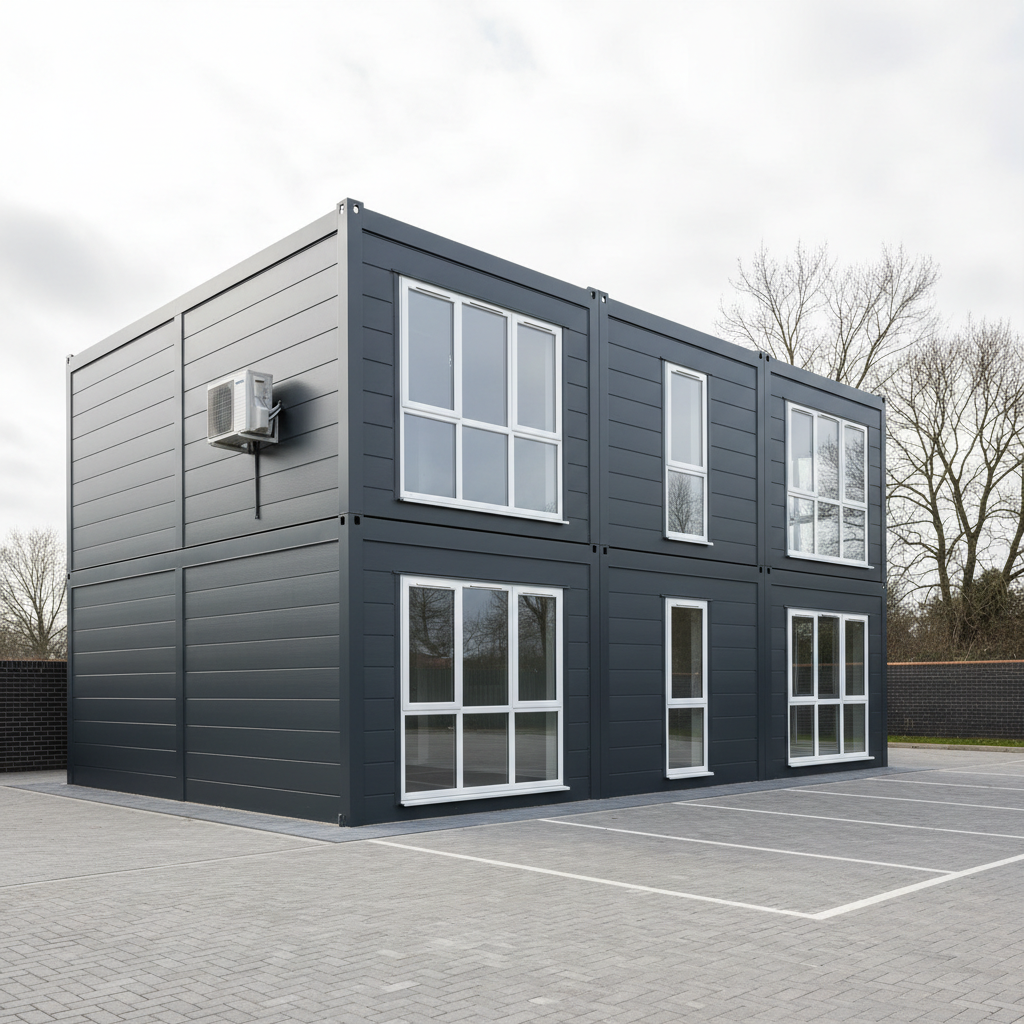
Modern climate control for Modular buildings has moved toward dual-function Air Conditioning units that utilize Air Source Heat Pump (ASHP) technology. These systems are not just for cooling; they are highly efficient heaters that can be three to four times more efficient than standard electric radiators. In a typical P600 installation, a wall-mounted "split system" is the most common configuration, consisting of an internal head unit and an external condenser.
Efficiency and Performance:
An ASHP works by moving heat rather than generating it. In winter, it extracts heat from the outside air (even in temperatures as low as -15°C) and transfers it indoors. In summer, the process reverses. This results in a Co-efficient of Performance (COP) of around 3.0 to 4.0, meaning for every 1kW of electricity used, you get 3kW to 4kW of heating or cooling capacity. For a commercial buyer managing multiple modular offices, the energy savings over a five-year period can be substantial.
Dehumidification:
One often-overlooked benefit of AC in the UK is its ability to act as a dehumidifier. By removing excess moisture from the air, these systems help maintain a crisp, dry environment that protects sensitive electronic equipment and improves the overall air quality for staff. This is particularly valuable for site offices located in damp or coastal environments.
Cost-Benefit Analysis for Commercial Buyers
When procurement teams evaluate energy efficient modular offices UK options, the Return on Investment (ROI) is the central metric. While a standard electric heating setup might add only £200–£400 to the module cost, a professional split-system AC installation typically ranges from £1,500 to £2,500 per unit depending on the BTU rating and brand.
"While the upfront cost of AC is higher, the reduction in monthly energy bills and the increase in year-round staff productivity often result in the system paying for itself within 24 to 36 months of operation."
Productivity and Retention:
For a business, the cost of a staff member losing focus due to an overheated office is far higher than the cost of the AC unit. Providing a climate-controlled environment is now a standard expectation for modern recruitment and retention. Additionally, modular buildings fitted with high-spec HVAC systems hold their asset value better on the secondary market. If a contractor intends to sell their P600 modules after a project concludes, units with integrated AC are significantly more desirable.
Tax Considerations:
Commercial buyers should also consult with their accountants regarding Capital Allowances. In many cases, energy-efficient plant and machinery, such as air source heat pumps, may qualify for tax relief under the Annual Investment Allowance (AIA), effectively reducing the net cost of the upgrade.
Installation and Integration in P600 Modules
Integrating portable building climate control is most effective when planned at the design stage. At Adacon, we recommend using the free P600 configurator to visualize where units will be placed. Designing the layout in 3D allows you to ensure that internal head units are not blocked by future furniture or partitions and that external condensers are placed away from walkways or noise-sensitive areas.
Factory Pre-Cabling:
When an AC system is selected as an option, the P600 module can be pre-cabled at our production facility. This ensures that the high-load electrical requirements of the HVAC system are properly integrated into the consumer unit and that the structural integrity of the insulated panels is maintained. We use specialized grommets and seals for any penetrations through the wall panels to ensure there are no cold bridges or leaks in the thermal envelope.
Multi-Module Runs:
For large-scale projects like a modular café or a double-storey office block, we plan the external condenser placement to be aesthetically discreet. For two-storey builds, condensers can be ground-mounted or bracketed to the steel frame, ensuring easy access for annual maintenance without requiring specialist scaffolding.
Regulatory Compliance and Sustainability
Compliance with UK Building Regulations, specifically Part L (Conservation of Fuel and Power), is increasingly rigorous for both permanent and temporary structures. Adacon buildings are designed to meet these standards through high-performance insulation, but the choice of heating system plays a major role in the overall carbon footprint of the site.
Carbon Reduction:
Switching from resistive electric heating to an ASHP-based AC system can reduce the carbon emissions associated with heating by over 60%. For local authorities and large construction firms with strict Net Zero targets, this is a critical factor in the procurement process.
Health and Safety:
Ventilation is equally important. Under the Workplace (Health, Safety and Welfare) Regulations 1992, employers must ensure that every enclosed workspace is ventilated by a sufficient quantity of fresh or purified air. Modern AC units help circulate air, and when combined with trickle vents in our uPVC windows, they ensure a healthy CO2 balance. Furthermore, commercial landlords must ensure that any AC system with a cooling capacity of over 12kW is inspected every five years by an energy assessor (TM44 inspections).
Scenario Planning: Gatehouses vs. Open-Plan Offices
The "best" climate control solution depends entirely on the building's intended use. Different scenarios require different approaches to modular office heating.
Security Gatehouses:
In a gatehouse, the door is opened frequently as staff check vehicles or visitors. This results in rapid heat loss. In these cases, a powerful over-door air curtain or a fast-acting infrared heater may be more effective than a traditional AC unit, which would struggle to maintain a set temperature with constant drafts.
Open-Plan Offices and L-Shapes:
In a large open-plan P600 configuration, a single AC unit may not be enough. We recommend "zoning" the space with multiple smaller units. This allows for more granular control; for example, if the sun is hitting the south side of an L-shaped building, that zone can be cooled while the shaded north side remains neutral. This prevents the "thermostat wars" often found in large offices.
School Blocks and Classrooms:
For educational settings, noise levels are a priority. Adacon selects HVAC units with low decibel ratings to ensure that the climate control does not interfere with teaching. In these environments, budget is often tight, so we focus on high-durability units that can withstand heavy daily use by students.
Future-Proofing Your Modular Investment
As technology evolves, the way we manage modular buildings environments is becoming more data-driven. Facilities managers are now looking for smart thermostat integration, allowing them to monitor and adjust temperatures across a fleet of welfare units or offices from a single central dashboard. This prevents units from being left at 25°C over a weekend, saving significant costs.
Scalability:
The beauty of the Adacon P600 system is its scalability. If you start with a two-module office and later expand to six, the climate control system can be expanded in tandem. By planning for HVAC loads in the initial electrical spec, you avoid costly retrofitting later.
As the UK continues its transition away from fossil-fuel-dependent heating, electric-based heat pump technology is the most future-proof investment for any modular project. Whether you are looking for a single garden studio or a complex 12-module commercial hub, the choice of climate control will define the comfort, cost, and sustainability of your building for years to come. To explore the options for your specific layout, you can use our 3D configurator to arrange your modules and request a detailed HVAC quotation based on your project requirements.
Design yours online — free
You can lay out a construction & materials project yourself in a few minutes with the free Adacon P600 configurator: arrange the modules in 3D, pick your windows, doors and cladding colours wall by wall, and see an estimated price straight away. There is no obligation and no salesperson — save the design and we will pick it up from there.
Prefer to talk it through? Request a free quote and we will come back with a specification and price for your project.
Cost breakdown
| System Type | Est. Upgrade Cost (per module) | Efficiency Rating | Annual Running Cost (Est.) |
|---|---|---|---|
| Electric Panel Heaters | £0 (Standard) | 100% | High |
| Wall-Mounted AC (ASHP) | £1,200 - £2,500 | 300% - 400% | Low |
| Multi-Split System (Large Office) | £3,500+ | 400%+ | Very Low |
At a glance
| Feature | Electric Convection | Air Conditioning (Heat Pump) |
|---|---|---|
| Capital Cost | Minimal | Moderate to High |
| Cooling Capability | None (Requires fans) | Full Refrigerated Cooling |
| Installation Complexity | Plug & Play | F-Gas Engineer Required |
| Heat Distribution | Localised (Hot spots) | Forced Air (Even spread) |
| Energy Consumption | 1kW in = 1kW heat | 1kW in = 3.5kW+ heat |
Frequently asked questions
Written by Adacon
Adacon UK designs, manufactures and delivers bespoke modular buildings across the UK for residential, commercial, education, hospitality, leisure and specialist applications. Buildings are designed around the space and use required: several standard module sizes are available, modules are joined side by side or stacked to form larger buildings, and bespoke configurations are considered where a project needs them — from garden rooms and offices to homes, classrooms, clubhouses, cafés, welfare facilities and two-storey buildings.