Modular Building Depreciation for Construction Companies: A Guide
TL;DR
Purchasing modular assets like the P600 system allows construction firms to move from Opex to Capex, building balance sheet value across multiple projects. Unlike temporary hire units, these steel-framed modules offer predictable depreciation and high resale value. By project three, most owners find the cost-per-use significantly undercuts traditional plant hire rates.
The Financial Shift: Moving Infrastructure from Opex to Capex
For mid-tier and Tier 1 construction contractors, site infrastructure has traditionally been viewed as a necessary drain on project margins—a classic Operational Expenditure (Opex) model. When a firm wins a 24-month contract, the default procurement route is often to hire a fleet of site offices and welfare units. While this keeps initial capital in the bank, it creates a "dead money" scenario. At the end of two years, the contractor has paid out tens of thousands of pounds in hire fees, damage waivers, and delivery information surcharges, only to see the assets collected by the hire company, leaving the contractor with zero residual value.
Transitioning from hiring to owning modular building depreciation for construction companies offers a significant strategic advantage. By purchasing a fleet of Adacon P600 modules from a UK modular building supplier like Adacon, a company moves these costs from the profit and loss (P&L) statement to the balance sheet. Instead of a recurring monthly expense that vanishes once the project is complete, the site setup becomes a Capital Expenditure (Capex) asset that can be depreciated over time.
Consider a standard project pipeline. A contractor with a five-year outlook will likely complete three to four major site mobilisations in that period. Under a hire model, the cost of site welfare is incurred three to four times over. Under an ownership model, the capital investment is made once. The impact on project margin protection is profound: once the initial purchase cost is amortised—typically within 18 to 30 months—the cost of site infrastructure for all subsequent projects drops to the price of logistics and minimal maintenance. This shift builds significant balance sheet strength, providing the company with tangible assets that can be leveraged or sold if the business strategy changes.
Understanding modular buildings Depreciation for Construction Companies
A common misconception in the construction industry is that modular units lose value as rapidly as vehicles or specialized heavy plant. In reality, the high-specification galvanised steel-framed P600 modules are designed for a multi-decade lifespan, provided they are maintained correctly. When calculating modular building depreciation for construction companies, two primary methods are generally employed: straight-line and reducing balance.
Straight-line depreciation is often preferred for its simplicity. If a P600 module is expected to have a 10-year working life with a 10% residual value, the cost is spread evenly over 120 months. For example, a unit that costs approximately £12,000 (excluding VAT and delivery) might be depreciated at £1,080 per year. Alternatively, the reducing balance method applies a fixed percentage to the remaining book value each year, reflecting the fact that modular units, like all physical plant, may see a steeper drop in market value in the first 24 months before stabilising.
Residual value is where Adacon units diverge significantly from the "converted container" market. Because our buildings are purpose-built modular systems using insulated P-series panels rather than modified shipping crates, they maintain a higher resale price. Converted containers are often prone to interstitial condensation and structural fatigue from repeated modifications; conversely, a P600 unit remains a standardised, high-spec asset that is easy to value for resale to other contractors or for use as garden offices and small business premises.
From a tax perspective, Modular buildings often qualify for Capital Allowances. In the UK, these units are typically classified as "plant and machinery" rather than permanent structures, especially when they are relocatable. This classification can allow for significant tax relief through the Annual Investment Allowance (AIA) or other government-led tax incentives, potentially allowing for 100% of the cost to be deducted from taxable profits in the year of purchase. We strongly advise that all contractors consult with their qualified tax professional to confirm the specific treatment of these assets based on their current financial position.
Cost Analysis: Ownership vs. Repeated Long-Term Hire
The "break-even" point between hiring and owning is the critical metric for procurement teams. On average, the monthly hire rate for a high-specification Site offices can range from £80 to £150 per week, depending on the unit size and duration. Over a 24-month project, a single unit could cost upwards of £10,000 in hire fees alone. When you add the inevitable "hidden costs"—such as mandatory damage waivers (often 10-15% of the hire rate), admin fees for off-hiring, and non-negotiable delivery and collection surcharges—the total cost of hire often exceeds the purchase price of a new P600 module within 22 to 26 months.
The flexibility of the P600 system provides a further financial cushion. Unlike hire fleets, where you are often locked into specific configurations, Adacon modules can be adapted as headcount fluctuates. A contractor might start with four modules for a site office, and as the project grows, add two more for a canteen or site welfare units. At the end of the project, the units don't have to stay in that configuration. They can be split up: three units might go to the next project, while one is refurbished as a dedicated Security cabins for a different site.
"Ownership eliminates the 'off-hire anxiety' where contractors are billed for every scratch and dent upon return. When you own the asset, minor cosmetic wear in a high-traffic construction environment is a maintenance item, not a penalty fee."
Consider a 3-project cycle over six years.
- Project A (24 months): Hire cost £12,000 | Purchase cost £13,500 (incl. delivery).
- Project B (18 months): Hire cost £9,000 | Ownership cost £1,500 (relocation/service).
- Project C (24 months): Hire cost £12,000 | Ownership cost £1,500 (relocation/service).
Built for Re-use: Technical Spec and Asset Durability
The longevity of a modular asset is dictated by its build quality. Adacon modules are built around a robust galvanised steel chassis, ensuring they can be lifted, transported, and relocated dozens of times without structural degradation. This durability is why we never describe our units as "converted containers"—our P-series is a purpose-engineered modular system.
Precision in measurements is vital for site planning and compliance. The P600 module, our most popular commercial unit, features an external footprint of 12.98 m². The approximate usable internal area is 11.4 m² before any internal partitions are added. These dimensions (5.9m external length by 2.2m width) allow for efficient transport on standard HGVs while providing enough internal volume to meet HSE welfare requirements for headcount.
Standard inclusions across the range focus on commercial-grade durability:
- Insulated walls, floor, and roof: High-performance thermal envelopes that reduce heating costs compared to standard thin-walled hire units.
- 40mm waterproof insulated sandwich panels: Used as standard in all bathroom and wet-zone walls to prevent water damage and mould.
- Electrical fit-out: Every unit includes a consumer unit, LED lighting, and power sockets as standard.
- Galvanised chassis: Essential for preventing corrosion in the damp UK climate, especially for units stored between projects.
The Economics of Relocation and Site Mobilisation
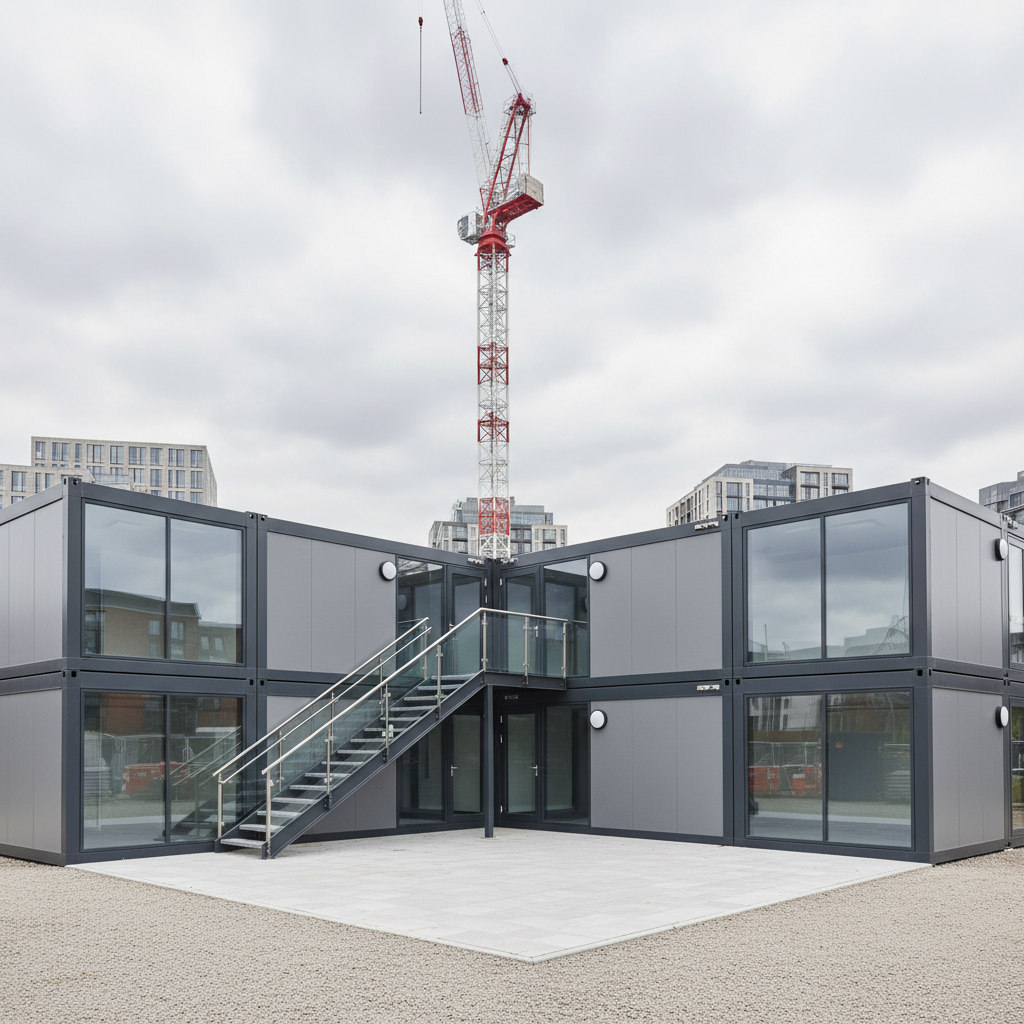
The true value of a relocatable asset lies in how easily it can be moved. Because Adacon units are standardised, they can be stacked or combined in various configurations to suit restricted urban site footprints. Modules can be joined side-by-side to create large open-plan boardrooms or stacked two-storeys high with internal or external staircases for site offices with limited ground space.
Lead times are a critical factor for contractors who need to mobilise quickly. While bespoke builds take time, Adacon frequently holds "Ready to Order" stock units that can be dispatched to a site in weeks, not months. This speed allows contractors to include ownership in their tender bids without fearing that site setup will delay the start date.
It is important to note that while the modules are highly portable, the logistics involve specific responsibilities. Transport is quoted separately per site and itemised in the quotation to ensure transparency across the UK mainland and Northern Ireland. The customer remains responsible for:
- Groundworks: Ensuring the site is accessible for heavy HIAB delivery vehicles.
- Base preparation: Providing a level, stable base (such as concrete pads or a compacted hardcore bed) to prevent structural twisting.
- Utility connections: Final electrical connection to a site consumer unit and all plumbing/drainage connections to mains or holding tanks.
ESG and the Circular Economy in Site Infrastructure
Environmental, Social, and Governance (ESG) reporting is becoming a mandatory part of the procurement process for public sector and large-scale private contracts. A significant portion of a construction project’s carbon footprint comes from temporary works. By investing in high-quality, reusable modular buildings, contractors can significantly improve their sustainability credentials.
Traditional "temporary" buildings are often poorly insulated, leading to high energy consumption for heating and cooling throughout the project. Adacon units, with their P-series insulated panels, offer superior thermal performance, lowering the operational carbon footprint of the site office. Furthermore, by choosing to reuse assets across multiple projects, contractors participate in the "circular economy," avoiding the waste associated with disposing of low-quality temporary cabins or the constant transport emissions of a hire fleet returning to a central depot between projects.
At the end of an Adacon building's very long life, the materials are highly recyclable. The galvanised steel chassis and wall panels can be processed through standard metal recycling streams, ensuring that the asset does not end its life in a landfill. Reporting on these sustainable procurement choices can be a deciding factor for clients who are increasingly looking for "Green" supply chains.
Standardised Customisation for Commercial Resale
One challenge of owning assets is ensuring they remain versatile. A unit that is too highly customised may be difficult to repurpose or sell. The Adacon system solves this through "standardised customisation." Using our free P600 configurator, buyers can arrange modules in 3D, placing windows, doors, and internal partitions exactly where they are needed while staying within the standard modular framework.
For specific commercial needs, upgrades such as hygiene panels (for food prep or clinical use), air conditioning, or bespoke external cladding can be added. However, because these are built onto the standard P600 frame, the unit retains its core value. A contractor can buy a unit as a high-spec sales suite with full-height glazing and premium cladding for one project, and then, after a simple refit, use it as a standard site office for the next.
Avoiding the "converted container" label is not just about aesthetics; it is about protecting the asset's valuation. Professional modular buildings are viewed as high-quality infrastructure, whereas shipping container conversions are often restricted by building control or local planning authorities due to poor thermal properties. By investing in a purpose-built system, contractors ensure their fleet remains compliant, efficient, and valuable for years to come.
Design yours online — free
You can lay out a construction & site setup project yourself in a few minutes with the free Adacon P600 configurator: arrange the modules in 3D, pick your windows, doors and cladding colours wall by wall, and see an estimated price straight away. There is no obligation and no salesperson — save the design and we will pick it up from there.
Prefer to talk it through? Request a free quote and we will come back with a specification and price for your project.
At a glance
| Feature | Traditional Hire Fleet | Adacon P600 Ownership |
|---|---|---|
| Financial Classification | Operating Expense (Opex) | Capital Asset (Capex) |
| Insulation Quality | Variable / Often Basic | High-spec Insulated Sandwich Panels |
| Customisation | Limited to Fleet Standard | Full Configurable (Glazing, AC, Layout) |
| End of Project | Units returned; no value retained | Asset retained for next site or resale |
| Long-term Cost | Increases with every project month | Decreases as asset is amortised |
Pros
- • Significant long-term cost savings vs high hire rates
- • Superior thermal performance and LED lighting as standard
- • Highly relocatable and stackable for site-specific constraints
- • Predictable depreciation and strong secondary market value
- • Rapid deployment from UK stock
Cons
- • Requires upfront capital expenditure or financing
- • Responsibility for storage between projects
- • Customer must manage own groundworks and connections
Frequently asked questions
Written by Adacon
Adacon UK designs, manufactures and delivers bespoke modular buildings across the UK for residential, commercial, education, hospitality, leisure and specialist applications. Buildings are designed around the space and use required: several standard module sizes are available, modules are joined side by side or stacked to form larger buildings, and bespoke configurations are considered where a project needs them — from garden rooms and offices to homes, classrooms, clubhouses, cafés, welfare facilities and two-storey buildings.