Garden Room vs Conservatory: Which is Best for Year-Round Use?
TL;DR
Garden rooms offer superior insulation and year-round usability compared to the seasonal temperature fluctuations of glass-heavy conservatories. While conservatories may seem traditional, P600 modular buildings provide a faster, more thermally efficient solution that often avoids complex planning hurdles. Use our online configurator to design your ideal space and receive an instant estimate.
When homeowners and commercial operators need to expand their footprint, the choice often narrows down to two popular options: a traditional glass conservatory or a modern insulated garden building. While both offer additional floor space, the functional differences between a glass-heavy structure and a steel-framed modular unit are significant, particularly when considering the UK’s volatile climate. Choosing between a garden rooms vs conservatory requires a deep dive into thermal performance, planning constraints, and long-term utility.
Defining the Difference: Construction and Materials
The primary distinction lies in the structural composition. A conservatory is defined by its transparency; historically, these structures must have at least 50% of their wall area and 75% of their roof area made of translucent materials (glass or polycarbonate) to be classified as such under certain UK building guidelines. They are typically "bolted on" to the rear of a property, relying on the host building for structural support or thermal buffering.
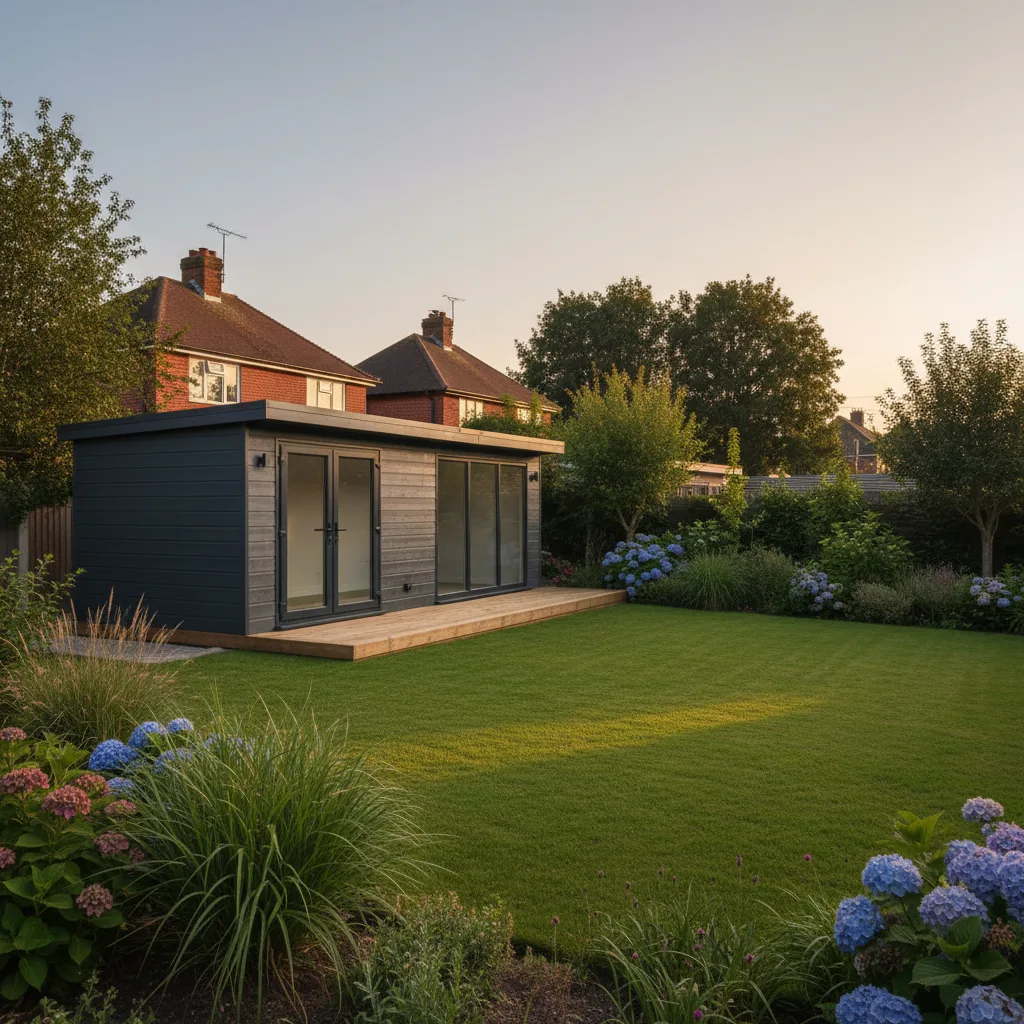
In contrast, modular units like the Adacon Adacon P600 system are standalone, high-performance structures. We utilize a precision-engineered steel frame, manufactured in our specialist facility in Turkey. Unlike "converted containers," which are limited by fixed dimensions and corrugated steel shells, our P600 modules are purpose-built for habitation. Each 13 m² module features fully insulated wall panels, integrated floor systems, and a roof designed to mimic the thermal envelope of a modern house. This shift from "add-on" glass rooms to standalone modular buildings allows for far greater flexibility in placement and use.
Thermal Performance: The Battle of Insulation
The biggest challenge with a traditional conservatory is the "greenhouse effect." In the summer months, the solar gain through a glass roof can make the internal temperature soar to over 30°C. Conversely, in winter, glass—even high-spec double glazing—has a significantly higher U-value (rate of heat loss) than a solid wall. This often results in a room that is too hot for July and too cold for January without significant expenditure on climate control.
The P300/P400/P600 modular range is designed for a consistent 20-degree environment. By using high-density insulation within the floors, walls, and roof, we achieve thermal efficiency that far exceeds a standard glass room. A standard P600 module arrives with double-glazed uPVC windows and doors as standard, but because the majority of the structure is insulated solid wall, the heat retention is vastly superior. For those looking to create a year-round garden office, this translates to lower electricity bills. Heating an insulated 13 m² module typically requires a fraction of the energy needed to keep a glass conservatory warm during a UK frost.
Planning Permission and Building Regulations
Navigating the legalities of property extension is a key hurdle for any buyer. Many detached garden buildings fall under "Permitted Development" (PD) rights, provided they meet specific criteria: they must be single-storey, have a maximum eaves height of 2.5 metres, and not occupy more than 50% of the land around the original house. Because Adacon modules are often used as standalone structures, they frequently bypass the need for full planning permission in residential settings.
Conservatories, while often covered by PD, can become complicated if they exceed certain size limits or if the property has already been extended significantly. Furthermore, there is the issue of "habitable room" status. A conservatory is often separated from the main house by external-grade doors to comply with Part L of the Building Regulations regarding heat loss. A fully compliant modular building, however, is built to a standard that can add genuine value to a property as a functional room. As rules are project-specific and vary by local authority, we always advise customers to verify their specific site requirements before installation.
Speed of Installation: Weeks vs Months
Traditional construction, including conservatories, involves a high degree of on-site disruption. You can expect weeks of groundworks, masonry, glazing installation, and internal finishing, all of which are weather-dependent. A rainy British autumn can easily push a conservatory project back by several months.
Adacon operates an off-site manufacturing model. Our P600 modules are built in a controlled factory environment, ensuring high precision and quality control. Lead times are typically measured in weeks rather than months, and for those in a hurry, we often hold "Ready to Order" stock units that can be dispatched even faster. delivery information is included for UK mainland and Northern Ireland. Once the unit arrives, it is lifted onto a pre-prepared level base. The internal finishes—including plastered and painted walls, laminate flooring, and LED lighting—are already complete. The customer is responsible for the groundworks and the final electrical connection to a consumer unit, but the time spent with contractors on-site is reduced from weeks to days.
Cost Analysis: Upfront Investment vs Long-term Value
When comparing modular building costs to conservatories, it is vital to look at the "all-in" price. A high-spec conservatory can cost anywhere from £15,000 to over £35,000 once you factor in the base, the structure, high-performance glass, and internal flooring. However, many owners find they need to spend thousands more on specialist blinds or air conditioning units to make the space usable year-round.
Adacon’s P600 modules start in the region of £12,000 to £18,000 for a single unit, depending on the chosen configuration of windows, doors, and cladding. This price includes the finished interior, meaning there are no hidden costs for plastering or decorating. For commercial buyers, such as those procuring site welfare units or modular classrooms, these buildings represent a relocatable asset. Unlike a conservatory, which is a permanent fixture of the house, a modular buildings can be dismantled and moved to a new site, protecting the capital investment.
Aesthetics and Customisation
A conservatory is aesthetically limited by its frame—usually white, anthracite, or wood-effect uPVC or aluminium. Because the P300/P400/P600 modular range uses a modular wall panel approach, we offer far more aesthetic control. Customers can use our free online configurator to select exterior cladding colours wall by wall. This allows the building to either blend into the garden with natural tones or stand out as a contemporary architectural feature.
Inside, the difference is even more pronounced. A conservatory feels like a glass box, often with exposed frames and wiring. An Adacon building feels like a premium indoor room, featuring smooth plastered walls and integrated electrics. Our P600 configurator allows you to place double-glazed windows and doors exactly where you need them, ensuring you have privacy from neighbours while still benefiting from natural light.
Versatility: From Garden Offices to Commercial Welfare
While homeowners often look at these structures for gyms, salons, or guest rooms, the P300/P400/P600 modular range is designed for heavy-duty commercial use as well. A conservatory is rarely, if ever, suitable for a professional security cabin, a sports clubhouse, or a retail pop-up because of its fragility and lack of privacy.
Our modules can be joined in runs, L-shapes, or stacked two-storeys high with internal staircases. This scalability makes them ideal for:
- Education: Rapidly deployed classroom blocks for academies.
- Construction: High-spec welfare units with integrated WCs and kitchenettes.
- Hospitality: Insulated cafés or holiday park reception hubs.
- Healthcare: Private consultation rooms for clinics.
"The ability to combine modules means a school can start with a single 13 m² unit and expand to a 150 m² block as their headcount grows—something impossible with a traditional conservatory."
The Environmental Impact
Sustainability is a core consideration in modern procurement. Traditional conservatories rely heavily on uPVC and glass, which have high embodied energy and can be difficult to recycle. Furthermore, their poor thermal efficiency leads to a higher carbon footprint over the building's life as owners crank up the heating to compensate for heat loss.
Adacon’s steel-framed modules are built for durability and longevity. The factory-controlled environment in Turkey minimizes material waste—typically producing 90% less waste than a traditional building site. The high-performance insulation ensures the building remains energy-efficient for decades. Finally, because the buildings are modular, they are inherently circular; if a building is no longer needed in one location, it can be relocated and repurposed rather than demolished and sent to landfill. For organizations tracking their ESG (Environmental, Social, and Governance) metrics, this makes modular units a far more responsible choice than temporary glass structures.
Whether you are a homeowner seeking a quiet garden retreat or a contractor needing robust site facilities, the P300/P400/P600 modular range offers a level of permanence and performance that a conservatory simply cannot match. You can explore the possibilities and get an instant price estimate by visiting the Adacon P600 configurator.
Design yours online — free
You can lay out a comparisons project yourself in a few minutes with the free Adacon P600 configurator: arrange the modules in 3D, pick your windows, doors and cladding colours wall by wall, and see an estimated price straight away. There is no obligation and no salesperson — save the design and we will pick it up from there.
Prefer to talk it through? Request a free quote and we will come back with a specification and price for your project.
Cost breakdown
| Feature | P600 Garden Room (Single Module) | Standard uPVC Conservatory |
|---|---|---|
| Estimated Price Range | £12,000 - £18,000 | £10,000 - £20,000 |
| Includes Delivery | Yes (UK Mainland) | Varies by builder |
| Internal Finish | Plastered, Painted, Laminate | Exposed Frame/Brick |
| Insulation | Full Wall/Floor/Roof | Glass/Polycarbonate Only |
At a glance
| Criterion | Garden Room (Modular) | Conservatory |
|---|---|---|
| Year-round Use | Excellent (Fully Insulated) | Poor (Seasonal) |
| Installation Time | 1-2 Days on site | 2-4 Weeks on site |
| Privacy | High (Solid Walls) | Low (All Glass) |
| Maintenance | Low (Modern Cladding) | High (Glass Cleaning) |
Frequently asked questions
Written by Adacon
Adacon UK designs, manufactures and delivers bespoke modular buildings across the UK for residential, commercial, education, hospitality, leisure and specialist applications. Buildings are designed around the space and use required: several standard module sizes are available, modules are joined side by side or stacked to form larger buildings, and bespoke configurations are considered where a project needs them — from garden rooms and offices to homes, classrooms, clubhouses, cafés, welfare facilities and two-storey buildings.