Choosing the Best Garden Room Heating Options for Your UK Build
TL;DR
Most garden rooms are best served by electric convection heaters for low upfront costs or air conditioning for year-round climate control. The P300/P400/P600 modular range’s high insulation levels significantly reduce the kW output required to maintain warmth. While underfloor heating offers luxury, infrared panels provide the most space-saving efficiency for smaller offices or studios.
Selecting the right garden room heating options is a critical decision that dictates the year-round usability and operational costs of any modular structure. Whether you are a homeowner installing a garden office or a commercial site manager procuring site welfare units, the efficiency of your heating system is inextricably linked to the building's thermal envelope. In the UK climate, where temperatures can fluctuate significantly between seasons, a well-considered heating strategy ensures that your space remains a productive environment rather than a seasonal luxury.
The Impact of Insulation on Heating Requirements
Thermal efficiency is the foundation of any effective heating strategy. Without high-performance insulation, any energy spent on heating is rapidly lost to the external environment, leading to high utility bills and uncomfortable internal temperatures. While traditional timber-framed sheds often struggle with draughts and thermal bridging, the Adacon Adacon P600 system is engineered as a fully insulated modular buildings from the outset.
The P600 modules are constructed with a robust steel frame and feature high-density insulation within the walls, floor, and roof. This design achieves superior U-values—the measurement of heat transfer through a material—compared to standard timber outbuildings. By minimising heat loss through the building fabric, the energy required to maintain a comfortable 20°C is significantly reduced. In a standard 13 m² module, the high thermal mass and airtightness mean that even a low-wattage heat source can effectively warm the space.
When calculating your heating requirements, the square footage is the primary metric. A single P600 module generally requires approximately 1kW to 1.5kW of heating capacity to maintain warmth during peak UK winter conditions. For multi-module configurations, such as a large modular classroom or a multi-room clubhouse, the open-plan nature of the joined modules allows for more flexible placement of heat sources, provided the total wattage meets the volumetric demand of the space.
Electric Convection Radiators: The Standard Choice
Wall-mounted electric radiators are the most common inclusion for modular builds due to their reliability and simplicity. As a UK modular building supplier, we find that the majority of commercial and residential clients prefer this option for its balance of upfront cost and performance. Unlike water-based central heating, electric radiators require no complex plumbing or boiler connections, making them ideal for rapid deployment on sites.
Convection radiators work by pulling cold air from the floor level, heating it via an internal element, and releasing it into the room. This creates a natural circulation of warm air. Modern units supplied with the P300/P400/P600 modular range feature digital thermostats and programmable timers. This allows a homeowner to set their garden offices to warm up 30 minutes before they start work, or a facility manager to ensure security cabins are heated only during specific shift patterns.
The maintenance requirements for electric convection heaters are virtually non-existent. There are no pipes to leak or pumps to fail. If a unit does reach the end of its lifespan after many years, replacement is a simple matter of unhooking the chassis from the wall and plugging in a new unit. For those looking for a functional, cost-effective solution, electric radiators remain the industry standard.
Infrared Heating Panels: Space-Saving Efficiency
For smaller garden rooms or specialist workspaces like salons where wall space is at a premium, infrared heating panels offer a modern alternative. Unlike convection heaters, which warm the air, infrared panels emit radiant heat that directly warms objects and people in the room. This is the same sensation as standing in direct sunlight; the air temperature may be lower, but the perceived warmth is high.
One of the primary advantages of infrared technology is the ability to mount panels on the ceiling. This keeps the walls entirely clear for desks, shelving, or salon equipment. In a 13 m² P600 module, a single 600W to 800W panel is often sufficient to provide comfortable working conditions. Because infrared does not rely on air movement, it also reduces the circulation of dust and allergens, which can be a significant benefit for users with respiratory sensitivities.
While the initial purchase price of infrared panels can be higher than standard electric radiators, their energy efficiency is often superior. Because they heat the thermal mass of the room rather than the air, the room stays warmer for longer even after the panel is switched off. This makes them an excellent low-energy heating option for home offices and small retail units.
Air Conditioning: Heating and Cooling for Year-Round Use
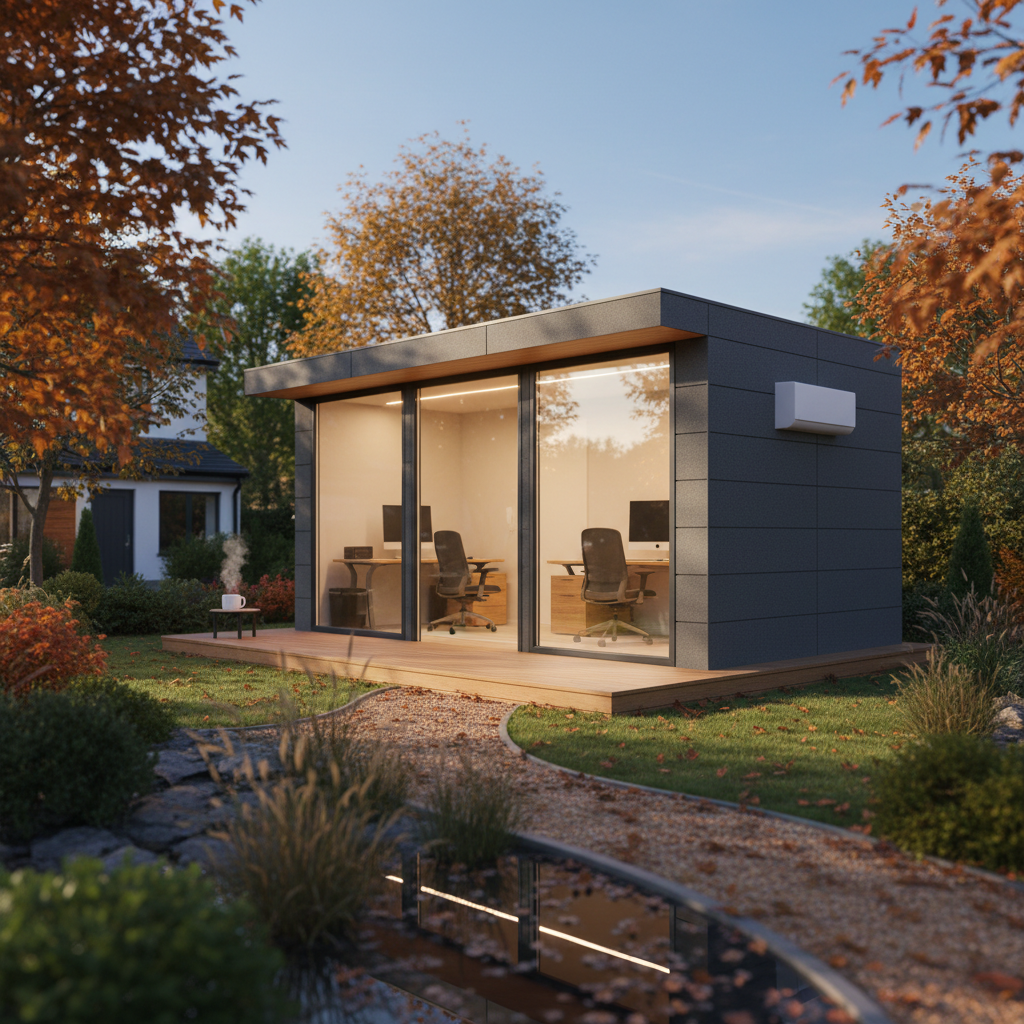
Air conditioning is no longer just for cooling; modern "split-system" units are actually air-source heat pumps. They are incredibly efficient at heating Modular buildings, often providing 3kW to 4kW of heat for every 1kW of electricity consumed. For south-facing modules or buildings with large expanses of glazing, air conditioning is often the most sensible choice to manage the UK’s increasingly warm summers while providing powerful heating in the winter.
The installation involves an internal wall-mounted unit and an external condenser. While the upfront cost is higher—typically ranging from £1,200 to £2,500 including professional F-Gas installation—the monthly running costs are lower than direct electric heating. In a garden gym, for example, the ability to switch to a cooling mode during a workout is a major advantage that other heating systems cannot match.
When choosing air conditioning for a P600 build, the external unit can be positioned discreetly behind the module. It is important to consider the placement of the internal unit to ensure even airflow across the room, particularly in L-shaped or multi-module layouts. As these units require external drainage for condensate, they are best planned during the initial design phase.
Underfloor Heating: The Luxury Option
Underfloor heating (UFH) provides a consistent, comfortable heat that emanates from the ground up, eliminating cold spots and freeing up all wall space. In modular constructions, electric mat systems are preferred over water-based (wet) systems. Electric mats are thinner, easier to install beneath the standard laminate flooring provided in Adacon modules, and do not require the depth of a traditional screed floor.
It is important to note that underfloor heating has a slower response time than radiators or air conditioning. It can take several hours to bring a room up to temperature from cold. Consequently, UFH is best suited for modules that are in constant use, such as a primary residence extension or a full-time café. If you only use your garden rooms for a few hours a day, the energy used to warm the floor might be wasted.
When opting for UFH, the insulation beneath the heating element is crucial. Adacon’s standard floor insulation helps direct the heat upwards into the room rather than losing it to the ground. However, users should be aware that thick rugs or heavy furniture placed over the floor can act as insulators, reducing the system's effectiveness. UFH also adds a small amount of height to the floor build-up, which must be considered at the threshold of the external uPVC doors.
Running Costs and Energy Consumption
Understanding the operational costs of low energy heating for home offices and commercial modules is essential for budgeting. Based on current UK electricity price caps (approx. 24p–28p per kWh), running a 1.5kW heater at full power for eight hours would cost roughly £3.00 to £3.50 per day. However, in a highly insulated P600 module, the heater will not run at full power constantly; once the thermostat reaches the set temperature, it will only cycle on occasionally to maintain it.
To keep costs low, we recommend the following strategies:
- Smart Thermostats: Using WiFi-enabled controls to ensure heating is only active when the building is occupied.
- Zonal Heating: In a multi-module school block or office, only heat the rooms currently in use rather than the entire building.
- Thermal Integrity: Ensuring the double-glazed uPVC windows and doors are fully closed and latched to maintain the air seal.
The efficiency of a 1kW output is identical across all direct electric heaters (radiators, infrared, UFH), but the perception of warmth varies. Infrared may allow you to set the thermostat 2°C lower while feeling just as warm, potentially saving 10-15% on annual bills. Air conditioning units remain the most energy-efficient due to their heat pump technology, though their higher purchase price means the "payback period" can be several years.
Installation and Electrical Requirements
All Adacon P600 modules come pre-wired with a consumer unit, LED lighting, and power sockets as standard. However, the choice of heating system impacts the internal electrical configuration. High-wattage heaters or multiple air conditioning units require dedicated circuits to prevent overloading the system. This is why heating requirements should be confirmed during the quotation process.
The P600 internal consumer unit is typically located high on an internal wall for easy access. While the internal wiring is completed at our production facility, the final connection from your home or business mains supply to the module must be performed by a qualified UK electrician. They will need to calculate the total load—including heating, lighting, and equipment—to ensure the supply cable (usually an SWA armoured cable) is of sufficient gauge.
For commercial clients deploying marketing suites or retail units, the relocatability of the P300/P400/P600 modular range is a key benefit. The electrical system is designed to be disconnected and reconnected if the module needs to be moved to a new site, making the heating investment a long-term asset rather than a sunk cost in a fixed location.
Customising Your Build via the P600 configurator
To help you visualise how different garden room heating options will fit into your project, we provide a free 3D tool. The P600 configurator allows you to arrange modules and place windows and doors, which in turn dictates the best positions for radiators or AC units. For example, you may choose to move a window to create a larger wall space for a vertical designer radiator or to ensure an infrared panel isn't blocked by tall furniture.
Within the configurator, you can also select your exterior cladding. If you are planning to install an external air conditioning condenser, you might choose a cladding colour that helps the unit blend into the building's aesthetic. The tool provides an instant estimated price, including the standard insulation and glazing packages that make our buildings so thermally efficient.
By using the configurator, you can plan your internal layout to ensure the heat source is positioned away from the desk to avoid direct glare, or centrally in a holiday park module to ensure even warmth for guests. Once your design is finalised, it is sent to our Turkey production facility where it is built to your exact specification and delivered to your UK site ready for final connection.
"The secret to a comfortable modular building isn't just a powerful heater; it's the quality of the envelope that keeps that heat inside. A P600 module is designed to perform in the British winter from day one."
Whether you are looking for a simple, cost-effective electric radiator or a high-efficiency air conditioning system, the modular nature of our buildings allows for total flexibility. By focusing on insulation first and choosing the right technology for your specific use case, you can ensure your Adacon building remains a comfortable, low-cost space for years to come. Start your journey by designing your layout on the P600 configurator today.
Design yours online — free
You can lay out a construction & materials project yourself in a few minutes with the free Adacon P600 configurator: arrange the modules in 3D, pick your windows, doors and cladding colours wall by wall, and see an estimated price straight away. There is no obligation and no salesperson — save the design and we will pick it up from there.
Prefer to talk it through? Request a free quote and we will come back with a specification and price for your project.
Cost breakdown
| Heating Type | Estimated Install Cost | Efficiency Rating | Best For |
|---|---|---|---|
| Electric Convector | £150 - £300 | Moderate | Occasional use & budget builds |
| Infrared Panels | £300 - £600 | High | Compact offices & studios |
| Air Conditioning (ASHP) | £1,200 - £2,500 | Very High | Year-round workspaces & gyms |
| Electric Underfloor | £500 - £900 | Low (Response-wise) | Luxury feel & barefoot comfort |
At a glance
| Feature | Convector | Infrared | Air Con |
|---|---|---|---|
| Heat Speed | Fast | Instant (Direct) | Fast |
| Cooling Mode | No | No | Yes |
| Space Used | Wall Space | Ceiling/Wall | Wall/External |
| Maintenance | None | None | Annual Service |
Frequently asked questions
Written by Adacon
Adacon UK designs, manufactures and delivers bespoke modular buildings across the UK for residential, commercial, education, hospitality, leisure and specialist applications. Buildings are designed around the space and use required: several standard module sizes are available, modules are joined side by side or stacked to form larger buildings, and bespoke configurations are considered where a project needs them — from garden rooms and offices to homes, classrooms, clubhouses, cafés, welfare facilities and two-storey buildings.