Relocatable Security Cabin ROI: Fixed vs Modular Guide
TL;DR
Modular security cabins offer significantly higher ROI than fixed builds due to their ability to be relocated as site footprints change. Adacon’s steel-framed P600 modules provide permanent-quality insulation and longevity while remaining classified as temporary structures for faster procurement. The primary financial benefit lies in asset retention; when a site layout changes, the building moves with the gate rather than being demolished.
Defining ROI in Security Infrastructure
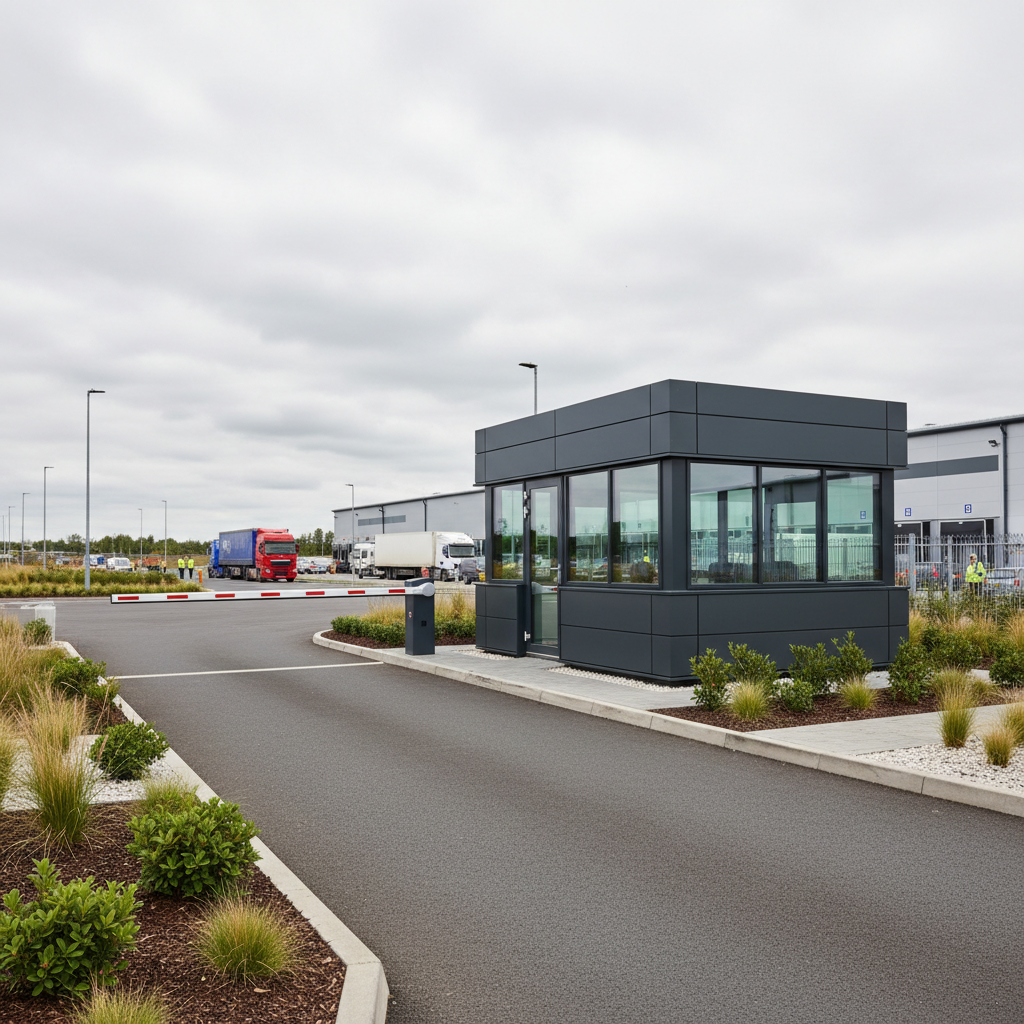
When evaluating the procurement of site security assets, Facilities Managers and Procurement Officers often view the Gatehouses or access control point as a necessary sunk cost. However, a relocatable Security cabins should be viewed as a high-utility asset that provides a measurable return on investment (ROI). In the context of a growing UK industrial site, a logistics hub, or an educational campus, the traditional approach of masonry construction represents a significant financial risk. Permanent brick-and-mortar structures are inflexible; if a site boundary expands or a traffic flow logic changes, a fixed building becomes an obstacle that requires expensive demolition.
The shift from heavy Capital Expenditure (CapEx) to high-utility modular assets allows organisations to align their infrastructure with operational reality. Unlike "portable" cabins which may lack structural longevity, or shipping-container conversions (which Adacon modular buildings are not), a purpose-built modular system provides the thermal performance and structural integrity of a permanent building with the flexibility of a temporary one. This flexibility is a primary ROI driver. If the building is no longer needed at the main gate, it can be repurposed as a site office or relocated to another facility entirely, preserving the initial investment.
Speed of deployment is the "hidden" ROI driver often overlooked in early-stage budgeting. While a traditional build might take 18 months from design to handover—subjecting the site to months of contractor traffic, noise, and security breaches—an Adacon P-series module can be specified, manufactured, and delivered in a matter of weeks. For a commercial operator, this means the security perimeter is active and the site is protected significantly sooner, reducing the period of risk and site disruption.
Direct Cost Analysis: Fixed vs. Modular
The financial comparison between a relocatable security cabin and a traditional fixed build begins long before the first brick is laid. For a permanent structure, groundworks are extensive. Deep strip foundations or concrete pads designed for heavy masonry are required, often costing between £5,000 and £15,000 depending on soil conditions. In contrast, Adacon modular units require a level, prepared base, such as a simple concrete pad or a series of structural piers, which significantly reduces the initial groundworks budget.
Professional fees further skew the ROI in favour of modular systems. A permanent build typically requires a bespoke architectural design, a structural engineer's report, and potentially a quantity surveyor, with fees often reaching 10% to 15% of the total build cost. With the Adacon system, the engineering is already integrated into the P-series modules. A buyer can use the P600 configurator to design a unit, receiving an instant estimated price that includes the structural chassis, insulated envelope, and basic electrical fit-out as standard.
Consider the procurement timeline. A traditional gatehouse project involves a lengthy tender process followed by an on-site build that is weather-dependent. A typical 12m² masonry gatehouse might cost £35,000 to £50,000 once all professional fees and groundworks are tallied, with a 6-month minimum construction window. A comparable Adacon Adacon P600 module, offering an external footprint of 12.98 m² and an approximate usable internal area of 11.4 m², can be delivered for a fraction of that total investment, with on-site "construction" limited to a single day for delivery information and off-loading. The reduction in site disruption alone can save a busy logistics firm thousands in avoided operational downtime.
Longevity and Build Quality: Beyond the Container
It is vital to distinguish between high-end modular systems and the "converted containers" often found on secondary markets. Adacon does not sell shipping containers. Our system is built on a purpose-engineered galvanised steel chassis. This is a critical distinction for long-term ROI. Shipping containers are prone to condensation, "sweating," and corrosion if the internal lining is not perfectly executed; furthermore, their fixed dimensions limit internal comfort. Adacon modules (P300 through P700) are designed from the ground up as habitable buildings.
The use of galvanised steel ensures the chassis remains resistant to the UK's damp climate, preventing the structural degradation that can plague timber-framed or inferior steel units. Thermal efficiency is another area where ROI is realised over the building’s lifecycle. Our modules use high-performance insulated sandwich panels for the walls, floor, and roof. A P600 unit, for instance, maintains internal temperatures far more efficiently than a thin-walled portable hut, leading to significantly lower energy bills for heating and air conditioning.
Maintenance requirements for a steel-framed modular unit are also lower than those for brick-and-mortar. There is no mortar to repoint, no damp proof course to fail, and the external finishes are designed for durability in industrial environments. This "set and forget" quality ensures that the facilities management team can focus on core site operations rather than building upkeep.
The Value of Relocatability in Evolving Sites
Strategic ROI is often tested when a site undergoes change. In a scenario where a manufacturing plant expands or a retail park undergoes a masterplan revision, the site entrance may need to move 50 metres or be relocated to a different access road. For a masonry gatehouse, this move is impossible; the building must be demolished, the waste sent to a landfill (incurring significant landfill taxes), and a new building commissioned at the new location.
An Adacon relocatable security cabin is a "Plug and Play" asset. Because it is built on a rigid steel chassis with integrated lifting points, it can be disconnected from the mains electricity and drainage, crane-lifted onto a flatbed trailer, and moved to its new position in a matter of hours. This avoids the waste of the original investment and the cost of a new build.
This relocatability also increases the asset's resale value. If a project concludes—such as a major infrastructure build—the security units can be sold on the secondary market or moved to the next project site. This liquidity is a feature of Modular buildings that simply does not exist for fixed real estate.
Planning, Permitting, and Building Regulations
While all buildings are subject to local authority oversight, modular units often benefit from faster approval cycles. If a structure is intended to be on-site for a limited duration, it may be treated differently under planning law, though we always advise checking with your local authority for project-specific rules. For permanent installations, the fact that Adacon units are manufactured to consistent standards simplifies the process of demonstrating compliance with UK Building Regulations regarding thermal performance and structural safety.
When planning for headcount and occupancy, precision is required. We provide exact measurements to assist with this: the P600 external footprint is 12.98 m², while the approximate usable internal area is 11.4 m² before partitions are added. This allows facilities teams to calculate exactly how many staff can comfortably work within the unit, ensuring compliance with workplace health and safety regulations regarding space. Whether you are building a modular classroom or a high-security gatehouse, these metrics ensure the building is fit for purpose from day one.
Security Staff Wellbeing and Performance
The ROI of a security building is also linked to the performance of the staff inside. A security guard who is cold, cramped, or working in a poorly ventilated space is less alert and more likely to leave the role, increasing recruitment costs. Adacon units come standard with LED lighting, power sockets, and high-quality insulation. Upgrading to include a WC compartment or a kitchenette within a P600 or P700 unit ensures that staff can remain on-station for 24/7 operations without needing to leave the security perimeter for breaks.
Visibility is the primary function of a gatehouse. We offer various glazing options that allow for 360-degree site visibility. Unlike basic portable cabins, our glazing is specified to prevent excessive heat loss in winter and solar gain in summer. Furthermore, the acoustic performance of our 40mm waterproof insulated sandwich panels provides a quiet environment, shielding staff from the noise of heavy HGV traffic and machinery, which is essential for maintaining focus during long shifts.
Sustainability and the Circular Asset Lifecycle
Modern procurement increasingly demands sustainable solutions. Traditional construction is carbon-intensive, involving heavy machinery, significant material waste, and the extensive use of concrete. Adacon’s off-site manufacturing process is inherently less wasteful. Materials are cut to precision in a controlled environment, and any waste is recycled at the point of manufacture.
The circular nature of the relocatable security cabin is its greatest sustainability asset. A module can begin its life as a security cabin, be refurbished five years later with new flooring and a different window configuration to serve as a marketing suite, and eventually be recycled at the end of its multi-decade life. The steel chassis is 100% recyclable, ensuring that the building does not contribute to the UK’s construction waste crisis.
Customising for High-Security Environments
A modular buildings does not have to look like a temporary hut. For corporate headquarters or high-end residential developments, external cladding can be added to match existing branding or architectural styles. From timber-effect finishes to modern composite panels, the aesthetic can be tailored to be as discreet or as prominent as the security strategy requires.
Integration of technology is seamless. The modular nature of the walls allows for the easy installation of third-party CCTV monitors, biometric access control hardware, and communications equipment. For larger sites, modules can be combined side-by-side or in L-shapes to create multi-room complexes that include a reception area, a search room, and a private office for the security manager. For those overseeing large-scale logistics hubs or sports clubs, these multi-P600 configurations provide a professional, scalable solution that grows with the organisation. To begin exploring these configurations and to get an instant estimated price, buyers should utilise the free P600 configurator, which allows for full 3D visualisation of the building before a single penny is spent.
Design yours online — free
You can lay out a security & access control project yourself in a few minutes with the free Adacon P600 configurator: arrange the modules in 3D, pick your windows, doors and cladding colours wall by wall, and see an estimated price straight away. There is no obligation and no salesperson — save the design and we will pick it up from there.
Prefer to talk it through? Request a free quote and we will come back with a specification and price for your project.
Cost breakdown
| Model | External Footprint | Approx. Internal Area | Standard Features |
|---|---|---|---|
| P300 | 6.38 m² | 5.4 m² | Steel chassis, insulation, door, LED light, socket, consumer unit |
| P600 | 12.98 m² | 11.4 m² | Steel chassis, insulation, door, LED light, socket, consumer unit |
| P700 | 15.18 m² | 13.4 m² | Steel chassis, insulation, door, LED light, socket, consumer unit |
At a glance
| Feature | Fixed Masonry Gatehouse | Adacon Relocatable Module |
|---|---|---|
| Construction Time | 4–8 Months | 2–6 Weeks |
| Relocatability | None (Requires Demolition) | High (Crane & Transport) |
| Tax Treatment | Building Improvement | Plant & Machinery / Equipment |
| Future Flexibility | Locked into original footprint | Expandable via additional modules |
Pros
- • Significant reduction in site downtime during installation
- • Asset value is retained as the building can be sold or moved
- • High thermal efficiency reduces ongoing HVAC costs
- • Predictable costs via the 3D configurator tool
- • Suitable for two-storey configurations if site space is limited
Cons
- • Delivery cost is separate and site-dependent
- • Groundworks and final utility connections require local contractors
- • Maximum single-unit width is fixed at 2.2m (external)
Frequently asked questions
Written by Adacon
Adacon UK designs, manufactures and delivers bespoke prefabricated modular buildings across the UK — factory-built off-site and delivered fitted out — for residential, commercial, education, hospitality, leisure and specialist applications. Buildings are designed around the space and use required: several standard module sizes are available, modules are joined side by side or stacked to form larger buildings, and bespoke configurations are considered where a project needs them — from garden rooms and offices to homes, classrooms, clubhouses, cafés, welfare facilities and two-storey buildings.