Grants for Sports Club Changing Rooms: A Funding Guide
TL;DR
Sports clubs can secure funding for modular pavilions by providing transparent, fixed-price evidence during the application phase. Adacon’s P600 configurator allows committees to generate instant 3D designs and estimated costs for changing rooms, social spaces, and referee facilities. This documentation helps meet the rigorous requirements of bodies like Sport England and the Football Foundation by proving project viability and cost-certainty.
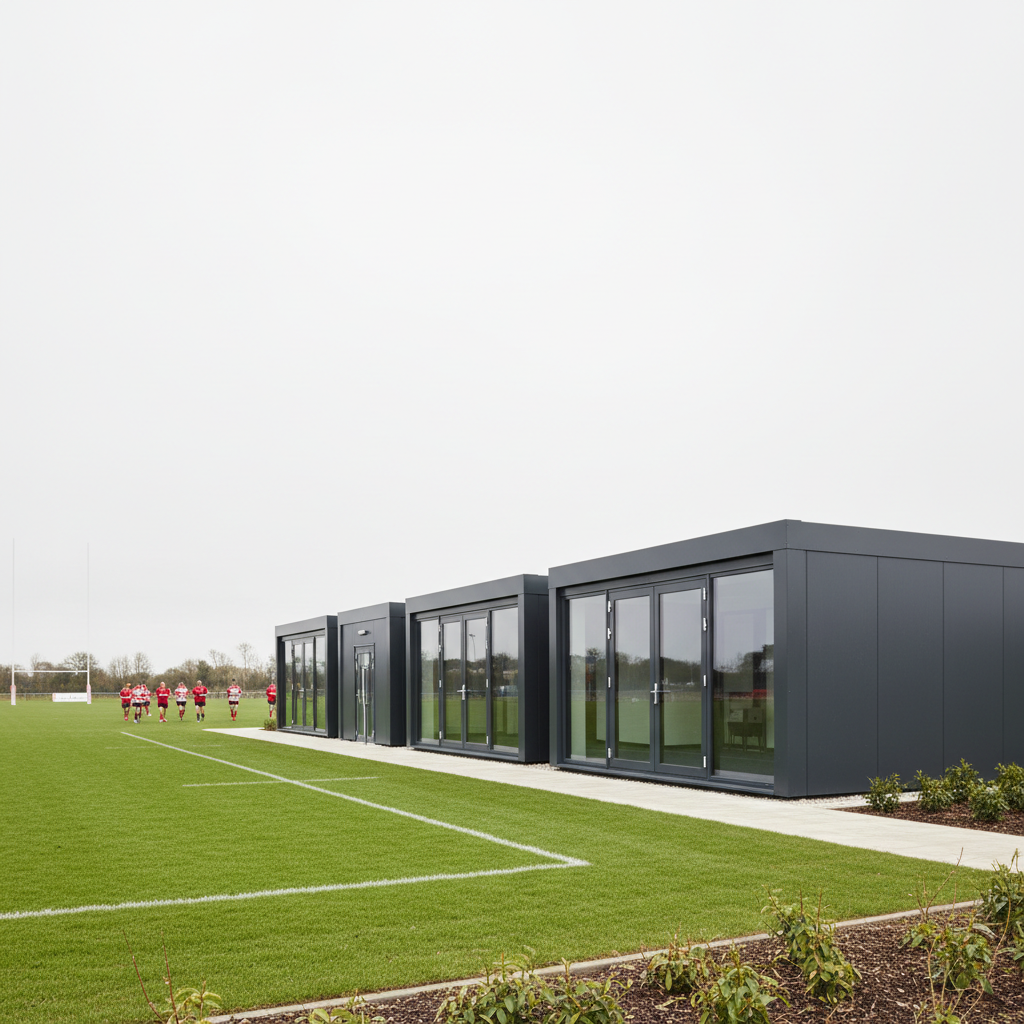
Securing grants for sports club changing rooms is often the difference between a grassroots club thriving or facing closure. In the UK, the demand for modern, hygienic, and inclusive facilities has never been higher, yet traditional construction costs often exceed the modest budgets of local committees. As a leading UK modular buildings supplier, Adacon provides a viable alternative to permanent bricks-and-mortar structures, offering high-specification modular changing rooms that meet the stringent requirements of national funding bodies. By opting for a modular approach, clubs can access professional-grade facilities with fixed-cost certainty and significantly reduced lead times.
The Funding Landscape for UK Grassroots Sport
The UK offers several primary avenues for sports infrastructure funding, though the criteria have shifted significantly in recent years toward projects that demonstrate sustainability and community inclusivity. Sport England is a major player, particularly through initiatives like the Queen’s Platinum Jubilee Activity Fund, which supports projects that bring people together. Similarly, the Football Foundation provides substantial grants for changing rooms, specifically targeting improvements in grassroots football infrastructure.
In Wales, Sport Wales offers the Be Active Wales Fund, while Sportscotland provides similar capital support for northern clubs. Beyond these national bodies, committees should investigate Section 106 agreements and the Community Infrastructure Levy (CIL). These are funds paid by developers to local authorities to mitigate the impact of new housing; often, these funds are ring-fenced for local "social infrastructure," including sports pavilions and community hubs. Accessing CIL funding requires a strong relationship with your local council and a clear demonstration of how the new building will benefit the wider public.
Grant bodies are currently prioritising "female-friendly" designs. This means moving away from large, communal "bunk-style" changing areas toward individual cubicles and enhanced privacy. Modular systems are ideally suited for this, as the internal layout can be partitioned to provide the exact ratio of showers to changing spaces required by National Governing Body (NGB) guidelines.
Why Modular Systems Appeal to Grant Bodies
When a grant committee reviews an application, they are assessing risk. Traditional construction is notorious for budget creep due to weather delays, material shortages, and unforeseen site issues. Modular buildings appeal to funders because they offer fixed-cost certainty. Because the Adacon P600 modules are manufactured in a controlled environment, the price quoted for the building itself remains stable, reducing the risk of a project stalling halfway through completion.
Sustainability is another key metric. Adacon’s P300, P400, P500, P600, and P700 range features high-performance insulated sandwich panels, which contribute to excellent thermal efficiency. This aligns with the "Green Heat" and carbon-reduction targets often found in modern grant criteria. Furthermore, the relocatability of a modular system provides better long-term value for money. If a club loses its lease or needs to reconfigure its grounds in ten years, the asset can be moved or sold, rather than being demolished. Finally, the speed of delivery information—often measured in weeks rather than months—means that grant money is converted into tangible community benefits almost immediately.
Using the P600 P600 configurator for Funding Applications
One of the biggest hurdles in a grant application is the "Vision" section. Committees need to see what they are buying. We recommend all clubs use the free P600 configurator to visualise their project in 3D. This tool allows you to arrange multiple modules in various configurations—side-by-side for a wide pavilion or L-shaped for a courtyard feel—and select the placement of windows and doors.
The configurator provides an instant estimated price, including the VAT, which allows a committee to set a realistic funding target without waiting for a site visit or a surveyor’s report. You can download the 3D renders and include them in your bid documents. A professional-looking visual, backed by a clear price estimate, significantly increases the credibility of a funding application compared to a hand-drawn sketch. It demonstrates that the club has performed its due diligence and has a "spade-ready" project waiting for approval.
Planning for Capacity: Footprints and Internal Areas
Accurate space planning is essential to ensure you meet NGB standards for squad sizes. When designing your layout, you must distinguish between the external footprint and the usable internal space. The P600 module has an external footprint of 12.98 m². However, for your internal capacity calculations, you should use the approximate usable internal area of 11.4 m² per module (based on internal dimensions of 5.7m x 2.0m).
For a standard 11-a-side football team, a single P600 module is generally too small to serve as a full Modular changing rooms once benches and kit bags are considered. Instead, clubs typically combine two or three modules side-by-side to create a large, open-plan changing area. By removing the internal joining walls, you create a seamless space. For example, a three-module P600 block would provide an approximate usable internal area of 34.2 m², which is ample for a full squad and coaching staff. When applying for grants for sports club changing rooms, ensure your plan includes separate modules for officials (referees) to comply with safeguarding regulations.
Standard Inclusions and Necessary Upgrades
Every Adacon module is supplied with a robust galvanised steel chassis, insulated walls, floor, and roof, an entrance door, LED lighting, power sockets, and a consumer unit as standard. This provides a high-quality "blank canvas." However, changing rooms have specific requirements that must be itemised in your grant request to avoid shortfalls.
For wet areas, such as showers and WCs, Adacon uses 40mm waterproof insulated sandwich panels as standard. We recommend budgeting for hygiene panel upgrades in high-traffic areas for easier cleaning. Beyond the basic structure, you will need to select windows, external cladding (to match existing buildings or meet planning requirements), and specialized non-slip flooring. If your club intends to use the building year-round, adding air conditioning for heating and cooling is a sensible addition to the grant bid. If the building is intended to be a multi-use modular clubhouse, consider adding a P600 module configured with a kitchenette to generate match-day revenue through tea and coffee sales.
Building a Strong Business Case
A successful grant application is essentially a business case. You must prove the "Need" versus the "Want." Start by auditing your current facilities—photographing damp, lack of accessibility, or insufficient capacity—to prove the necessity of the project. If your club is growing, highlight how the Adacon system allows for phased construction. You might apply for funding for two changing modules this year, with a plan to add a social module or a modular gym in year two as more funds become available.
Highlight the financial sustainability of the project. A new modular building isn't just a cost; it’s a revenue generator. By including a social space or café area, the club can demonstrate to funders how it will cover the building's future maintenance costs. Additionally, emphasize lead times. If your current facilities have been condemned or are at risk of closure, the fact that Adacon can deliver "Ready to Order" stock units in a matter of weeks can be a powerful argument for urgent funding approval.
Groundworks and Connections: The Club’s Responsibility
A common mistake in funding applications is forgetting to include the costs of site preparation. Adacon provides the building, but the groundworks, drainage, and final utility connections are the customer's responsibility. These are quoted separately and must be factored into your total grant request.
You will need a level, prepared base. Depending on your soil type and the permanency of the building, this could be a concrete pad or a series of steel screw piles (which are often preferred for modular builds due to their lower environmental impact). You must also account for the cost of a qualified electrician to make the final connection from your site’s main supply to the building’s consumer unit, and a plumber to connect the waste to the mains drainage or a septic tank. Budgeting approximately £3,000 to £7,000 for these works (depending on the distance to services) is a realistic starting point for most small-to-medium projects.
Navigating Planning Permission and Building Regulations
It is a common misconception that modular buildings do not require planning permission because they are "portable." In almost all cases involving sports clubs, planning permission will be required, especially if the building is in place for more than 28 days. Furthermore, if the building exceeds a certain size or is used by the public, it must comply with UK Building Regulations, covering aspects like structural integrity, fire safety, and thermal performance.
We advise committees to consult their local authority's planning department early in the process. Mentioning that you are using a professional modular system from a UK supplier like Adacon can often smooth the process, as we can provide the necessary technical specifications and floor plans to support your application. Building Regulations compliance is a project-specific matter, and you should ensure your grant covers the cost of any professional fees associated with these approvals. By being proactive with planning, you show grant bodies that your project is viable and legally compliant, making their decision to award funds much easier.
Design yours online — free
You can lay out a sport & leisure project yourself in a few minutes with the free Adacon P600 configurator: arrange the modules in 3D, pick your windows, doors and cladding colours wall by wall, and see an estimated price straight away. There is no obligation and no salesperson — save the design and we will pick it up from there.
Prefer to talk it through? Request a free quote and we will come back with a specification and price for your project.
Cost breakdown
| Module Type | External Footprint | Approx. Usable Internal Area | Common Sport Use Case |
|---|---|---|---|
| P300 | 6.38 m² | 5.4 m² | Referee changing or kit storage |
| P600 | 12.98 m² | 11.4 m² | Single team changing area |
| 2 x P600 (Linked) | 25.96 m² | 22.8 m² (Combined) | Full team room with integral showers |
| 3 x P600 (Linked) | 38.94 m² | 34.2 m² (Combined) | Small clubhouse with kitchenette and WC |
Frequently asked questions
Written by Adacon
Adacon UK designs, manufactures and delivers bespoke modular buildings across the UK for residential, commercial, education, hospitality, leisure and specialist applications. Buildings are designed around the space and use required: several standard module sizes are available, modules are joined side by side or stacked to form larger buildings, and bespoke configurations are considered where a project needs them — from garden rooms and offices to homes, classrooms, clubhouses, cafés, welfare facilities and two-storey buildings.