Modular Welfare Unit Prices: Hire vs Purchase Analysis
TL;DR
For construction projects exceeding 12-18 months, purchasing an Adacon P600 modular unit often costs less than cumulative weekly hire fees. While hire offers low initial outlay, ownership provides an asset with residual value, better insulation performance, and zero 'off-hire' damage disputes. Use our configurator to compare your specific site requirements against standard rental specs.
Understanding the Shift from Hire to Ownership
For decades, the standard procurement model for construction site welfare facilities has been short-term or long-term hire. While this approach offers immediate access to basic amenities, the landscape of UK construction is changing. Contractors and developers are increasingly evaluating modular Site welfare units prices against the cumulative costs of hire, finding that ownership of a high-specification asset often yields a superior return on investment. This shift is driven by a move away from the "throwaway" culture of basic site cabins towards high-performance, relocatable assets.
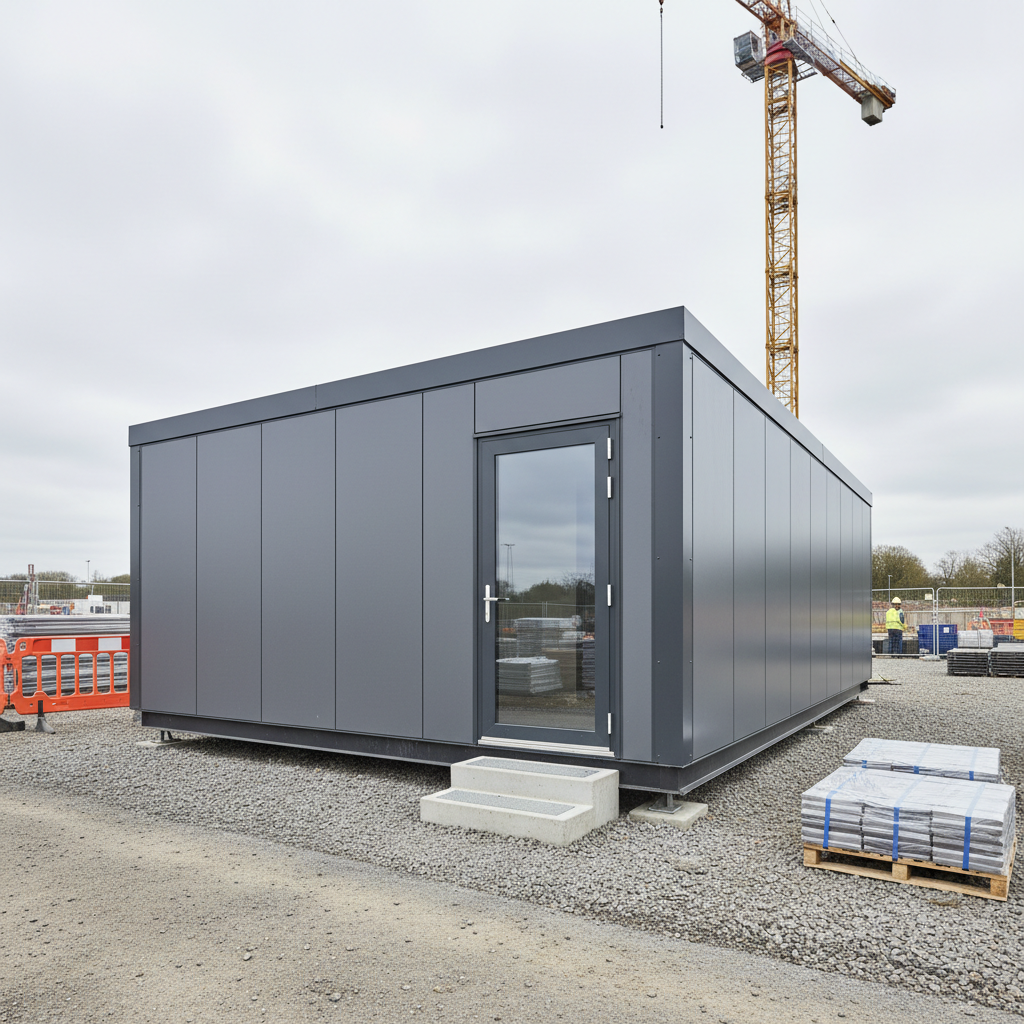
It is important to distinguish the Adacon system from standard hire stock. We are not a shipping-container reseller, and our buildings are never "converted containers." Instead, the Adacon P600 modular buildings is a purpose-engineered structure featuring a galvanised steel chassis and high-performance insulated sandwich panels. While a traditional hire cabin often suffers from poor thermal retention and a "functional" aesthetic that degrades over time, an owned site welfare unit provides a consistent, professional environment across multiple projects.
The decision to purchase rather than hire often hinges on project duration and frequency. For firms with a rolling pipeline of 12-to-24-month projects, the capital spent on hire disappears into a supplier's profit margin. By contrast, owning a fleet of P600 units allows a contractor to treat their welfare facilities as a depreciable asset that can be refurbished, rebranded, and relocated as needed. With an external footprint of 12.98 m² per P600 module, these units are easily transportable while providing a robust, insulated space that meets modern expectations for site staff comfort.
The True Cost of Welfare Hire: Beyond the Weekly Rate
When comparing modular welfare unit prices, many procurement teams fall into the trap of looking only at the weekly hire rate. In the UK, a standard 20ft welfare unit might be quoted between £80 and £150 per week, but the "headline rate" is rarely the final cost. The financial erosion typically begins with "ins and outs"—the delivery information and collection charges which, depending on site location and crane requirements, can range from £500 to over £1,500 per movement.
Beyond logistics, there are several hidden fiscal drains associated with hiring:
- Minimum Hire Periods: Most hire contracts stipulate a minimum period, often 26 to 52 weeks. If a project finishes early, the contractor is still liable for the remaining balance.
- Early Termination Fees: Conversely, extending a hire period last minute often results in inflated "off-contract" rates.
- Insurance and Liability: Hired-in plant insurance premiums are a necessary overhead. In the event of damage, the hirer is liable not just for repairs, but often for the "loss of hire" income the supplier suffers while the unit is out of commission.
- Damage-on-Return: This is perhaps the most significant hidden cost. Hire companies frequently levy high charges for minor floor scuffs, wall marks, or damaged electrical fixtures upon collection.
By owning an Adacon module, these variable costs are eliminated. The contractor controls the maintenance schedule, and the "damage" is simply wear and tear on their own asset rather than a penalty-heavy invoice from a third party.
Modular Welfare Unit Prices: Initial Capital Outlay
When discussing the purchase of a professional-grade module, it is vital to understand what the price includes. At Adacon, we provide transparent specifications so that commercial buyers can compare like-for-like. Our primary module for site use is the P600. It has an external footprint of 12.98 m² and an approximate usable internal area of 11.4 m² before partitions are added. These measurements are precise; we do not use "bare floor area" as a metric because it fails to account for the thickness of the high-performance insulated walls.
The standard specification for an Adacon P600 includes:
- A fully galvanised steel chassis for long-term corrosion resistance.
- Insulated walls, floor, and roof panels.
- A secure entrance door.
- Internal LED lighting and power sockets.
- A pre-installed consumer unit.
While the basic shell provides the structure, most site office procurement requires specific internal configurations. Upgrades such as WC compartments, kitchenettes with sinks and water heaters, and air conditioning units are priced based on the specific design. For example, a bathroom fit-out as standard uses 40mm waterproof insulated sandwich panels, ensuring durability in high-traffic environments. Because these are bespoke builds, we encourage users to visit the P600 configurator to arrange their layout and receive an instant estimated price based on their exact requirements.
It is standard practice in the modular industry to request a quote transport and groundworks separately. Since delivery costs to Northern Ireland differ from those in the UK mainland, and a site in central London requires different logistics than a rural site in the Highlands, these items are always itemised clearly in an Adacon quotation. The responsibility for a level, prepared base and the final electrical/drainage connections remains with the customer, allowing local trades to manage the site-specific interface.
Calculating the Breakeven Point
To determine the viability of purchasing, one must conduct a breakeven analysis. If we take a mid-range weekly hire rate for a welfare-spec unit at £120 per week, the annual hire cost is £6,240. Over a three-year project cycle, that is £18,720 spent with zero equity. When you add £2,000 for delivery and collection and an estimated £1,500 in damage charges over three years, the total cost of hire approaches £22,220.
The "Cross-Over Month"—the point at which the cost of hire exceeds the P600 modular building cost—typically occurs between month 18 and month 30, depending on the internal specification chosen. However, the calculation changes significantly when you factor in the residual value. Unlike a hired unit, an Adacon module is a saleable asset. A well-maintained steel-framed module can retain 50-70% of its value after five years. When this residual value is subtracted from the initial purchase price, the "real" cost of ownership often beats hire costs in as little as 12 to 14 months.
Furthermore, the ROI improves when modules are combined. The P600 system allows for modules to be joined side-by-side or stacked over two storeys. A two-storey modular classroom or large-scale site canteen uses the same core system but scales the utility of the footprint. By increasing the density of the staff headcount per square metre of land used, contractors can reduce their site footprint and associated land-use costs.
Operational Savings: Insulation and Energy Efficiency
A significant but often overlooked part of the cost analysis is the daily running cost. Traditional hire fleets often consist of older "jackleg" cabins with minimal insulation and single-glazed windows. In the UK climate, these units require constant heating in winter and become stifling in summer, leading to high electricity bills.
Adacon modules are engineered for thermal efficiency. The insulated sandwich panels provide a high-performance building envelope that significantly reduces HVAC running costs over a 52-week cycle. For a commercial buyer managing 10 units across various sites, the savings on electricity alone can amount to thousands of pounds per annum. This efficiency also helps firms meet their ESG (Environmental, Social, and Governance) targets by reducing the carbon footprint of their site operations.
Standard inclusions like LED lighting further drive down energy consumption compared to the fluorescent tubes often found in older hire stock. When contractors specify double glazing through the configurator, they are not just buying comfort; they are investing in a lower-cost operational model that pays dividends every month the unit is in use.
HSE Compliance and the P600 Specification
In the UK, CDM regulations welfare requirements are non-negotiable. The Health and Safety Executive (HSE) mandates that workers must have access to adequate toilets, washing facilities (including hot and cold water), a place to change and dry clothing, and an area to rest and eat. Failure to provide these can lead to site closures and heavy fines.
The P600 module is designed specifically to meet these HSE welfare requirements. By using 40mm waterproof insulated sandwich panels for bathroom zones, we ensure the facilities are not only compliant but also easy to clean and maintain—a vital factor for hygiene. The 11.4 m² approximate usable internal area of a single P600 module can be partitioned to include:
- A private WC and washbasin area.
- A separate drying room for wet weather gear.
- A kitchenette and seating area for breaks.
As headcount increases, the modular nature of the system allows for seamless expansion. You can add a second P600 module dedicated entirely to a canteen, or a P300 module for additional toilet capacity. This scalability ensures that your site remains compliant throughout the various phases of the build, from initial groundworks to final fit-out.
Tax Advantages and Asset Depreciation
From a financial perspective, the choice between hire (OpEx) and purchase (CapEx) has significant tax implications. Temporary building tax relief is a complex area, but Modular buildings often qualify for the Annual Investment Allowance (AIA). This allows many UK businesses to deduct the full value of qualifying plant and machinery—which often includes modular welfare units—from their profits before tax.
"Modular units are frequently treated as 'chattels' rather than permanent structures. This distinction is crucial for both planning permission and tax treatment, as it generally allows for faster depreciation and different capital gains considerations compared to traditional bricks-and-mortar buildings."
While hire payments are fully deductible as a business expense, they leave the company with no assets. Purchasing an Adacon unit places a high-value asset on the balance sheet. Over time, the asset depreciates, providing a tax shield, while the unit itself continues to provide utility long after it has been "paid for" in tax terms. We always advise commercial clients to consult with their financial advisors to understand how modular assets fit into their specific tax strategy, particularly regarding capital allowances for energy-efficient buildings.
Logistics: Delivery, Foundations, and Relocation
One of the primary advantages of the Adacon system is its modular unit relocation costs. Unlike permanent builds, these units are designed to be moved. Each module features dedicated lifting points, making it straightforward for a standard HIAB or crane to load the unit onto a flatbed truck for transport to the next project.
However, successful deployment requires proper site preparation. The customer is responsible for providing a level, prepared base—whether that be concrete pads, a compacted hardcore surface, or timber sleepers. Because our units are steel-framed and rigid, they do not require the extensive strip foundations of a traditional building, which significantly reduces the cost of "groundworks."
When planning your budget, consider the following logistical elements:
- Transport: As a UK modular building supplier, we quote delivery based on the specific mileage from our production facilities to your site. UK mainland and Northern Ireland are itemised separately to ensure accuracy.
- Electrical Connection: While the unit comes with a consumer unit and internal wiring, a qualified electrician must make the final connection to the site supply.
- Plumbing: Connections to mains water and sewage (or a waste tank) are the responsibility of the site contractor.
Configuring Your Welfare Fleet
The era of waiting days for a quote for a basic site cabin is over. We believe in providing our clients with the tools to design their own solutions. Our free P600 configurator allows you to visualize your welfare unit in 3D. You can experiment with different window placements to maximize natural light, choose door positions that suit your site’s flow, and even add external cladding if the unit needs to be placed in a sensitive area or needs to match your corporate branding.
Commercial buyers can use this tool to quickly draft different configurations—such as an L-shaped café or a multi-storey clubhouse—and get an instant estimated price. This transparency removes the pressure of the traditional sales process, allowing you to build a business case based on real figures and exact specifications. Whether you need a single portable canteen or a full-scale multi-unit welfare complex, the process starts with a design that meets your specific headcount and site constraints.
Design yours online — free
You can lay out a prices & costs project yourself in a few minutes with the free Adacon P600 configurator: arrange the modules in 3D, pick your windows, doors and cladding colours wall by wall, and see an estimated price straight away. There is no obligation and no salesperson — save the design and we will pick it up from there.
Prefer to talk it through? Request a free quote and we will come back with a specification and price for your project.
Cost breakdown
| Module Model | External Footprint | Approx. Usable Internal Area | Standard Features |
|---|---|---|---|
| P300 | 6.38 m² | 5.4 m² | Steel chassis, insulation, door, LED light, sockets |
| P600 | 12.98 m² | 11.4 m² | Steel chassis, insulation, door, LED light, sockets |
| P700 | 15.18 m² | 13.4 m² | Steel chassis, insulation, door, LED light, sockets |
At a glance
| Feature | Hiring Welfare Units | Purchasing Adacon P600 |
|---|---|---|
| Upfront Cost | Low (Weekly rate) | Higher (Capital investment) |
| Long-term Cost (>2 yrs) | Very High | Low (Asset pays for itself) |
| Customisation | Limited to stock | Full control via Configurator |
| Thermal Efficiency | Variable / Often Poor | High (PIR/Mineral Wool insulation) |
| End of Project | Unit returned, no equity | Asset retained or resold |
Pros
- • Significant cost savings on projects longer than 18 months
- • Custom layout for kitchens, drying rooms, and WCs
- • Superior thermal insulation reduces site energy bills
- • Ownership avoids costly 'damage' disputes at project end
- • Asset can be rebranded and moved between multiple sites
Cons
- • Requires higher initial capital outlay
- • Customer is responsible for long-term maintenance
- • Requires coordination of own transport between sites
- • Storage costs if unit is not needed between projects
Frequently asked questions
Written by Adacon
Adacon UK designs, manufactures and delivers bespoke modular buildings across the UK for residential, commercial, education, hospitality, leisure and specialist applications. Buildings are designed around the space and use required: several standard module sizes are available, modules are joined side by side or stacked to form larger buildings, and bespoke configurations are considered where a project needs them — from garden rooms and offices to homes, classrooms, clubhouses, cafés, welfare facilities and two-storey buildings.