Modular Holiday Lodge vs Static Caravan: Value and Longevity
TL;DR
While static caravans offer lower entry costs, Adacon's steel-framed modular lodges provide superior insulation and structural longevity for year-round revenue. Unlike lightweight timber-frame caravans, our P-series modules resist coastal corrosion and offer a 25+ year lifespan. Operators can configure bespoke layouts using the P600 online tool to maximise site yield and premium rental rates.
Choosing between a traditional static caravan and a modular Holiday lodges is a decision that dictates the long-term profitability and maintenance schedule of a holiday park or private leisure plot. While the UK leisure industry has long been dominated by the static caravan model, operators are increasingly moving toward steel-framed modular systems to overcome the limitations of timber-frame depreciation and seasonal thermal inefficiency. Understanding the technical distinctions between these two forms of transportable holiday accommodation is essential for securing a high return on investment and ensuring guest comfort throughout the UK’s varied weather cycles.
Defining the Difference: Chassis vs. Structure
The primary distinction between a static caravan and an Adacon modular buildings lies in the structural integrity of the frame. Traditional static caravans are typically constructed using a lightweight timber frame fixed to a steel chassis. While this makes them relatively light for transport, it also makes the structure susceptible to movement, moisture ingress, and degradation over time. In contrast, Adacon lodges are built using a full galvanised steel-framed P-series structure, encompassing the chassis, floor, walls, and roof in a rigid, integrated cage.
It is important to clarify that Adacon is a UK modular building supplier, not a shipping-container reseller. We never describe our buildings as "converted containers." While shipping containers are designed for sea freight and require heavy modification for human habitation, our P-series modules are purpose-built from the ground up for occupancy. A Adacon P600 module, for example, features a precision-engineered steel frame designed specifically to house high-performance insulation panels, providing a level of structural rigidity that timber-framed caravans cannot match.
This structural difference affects ground preparation. Because a modular building is significantly heavier than a timber-framed caravan, a level, prepared base is a strict requirement. This ensures the steel framed holiday lodges remain stable and that doors and windows stay perfectly aligned over decades of use. While caravans may be sited on simple slabs or even compacted hardcore, a modular lodge requires a more robust foundation, typically a concrete pad or reinforced plinth system, which is the customer's responsibility to arrange.
Year-Round Thermal Performance
One of the most significant challenges for UK holiday park operators is extending the rental season into the colder months. Traditional static caravans, even those built to BS3632 residential standards, often struggle with thermal bridging and heat loss through the thin wall cavities. Adacon’s P-series units utilise high-density insulated sandwich panels as standard. These panels provide a continuous thermal envelope, significantly reducing the energy required to maintain a comfortable internal temperature.
In a modular building, thermal efficiency is measured by its ability to retain heat in winter and deflect it in summer. The P-series system includes an insulated roof and floor as standard, which prevents the "cold floor" syndrome common in older static caravans. For operators, this translates to lower running costs and the ability to market units for year-round occupancy, including the profitable Christmas and New Year periods. To further enhance guest comfort during UK summer peaks, air conditioning units can be specified during the design phase, providing climate control that is often difficult to retro-fit into lightweight caravan structures.
Structural Longevity in UK Coastal Environments
For sites located on the coast or in exposed cliff-top positions, the lifespan of a holiday unit is often dictated by its resistance to salt-air corrosion and high wind loads. A standard caravan chassis is prone to surface rust, which can lead to structural failure if not treated regularly. Adacon modules utilise galvanised steel frames, providing a high level of protection against the elements. This makes them particularly suited for coastal cafés, holiday park receptions, and premium lodges where longevity is a priority.
Maintenance requirements for a modular lodge are generally lower than those for a timber-framed unit. While a caravan might require external re-cladding or roof repairs after 10 to 15 years, a steel-framed modular building is designed for a much longer horizon. In terms of resale value, caravans tend to depreciate rapidly, often losing 50% of their value within the first five years. Modular buildings, due to their versatility and structural durability, tend to hold their value better, as they can be easily relocated and repurposed for different functions, such as modular offices or site welfare units.
Internal Area and Footprint Analysis
When planning a site layout, it is vital to distinguish between the external footprint and the approximate usable internal area. A single P600 module has an external footprint of 12.98 m². However, due to the thickness of the insulated walls, the approximate usable internal area is 11.4 m² before any internal partitions are added. We provide clear measurements for our entire range, from the P300 (2.9m external length) to the P700 (6.9m external length), all with a standard 2.2m external width.
Modular lodges excel in their flexibility. Unlike fixed "off-the-shelf" caravan floorplans, our units can be combined side-by-side, in runs, or even in L-shapes to create multi-bedroom accommodation. A two-module P600 setup provides approximately 22.8 m² of internal space, which can be configured with open joins to create a spacious living area and separate bedrooms. Prospective buyers can use the P600 configurator to arrange modules in 3D, allowing them to visualise spatial constraints and ensure the layout meets their specific headcount and occupancy needs.
Aesthetics and Customisation for Premium Branding
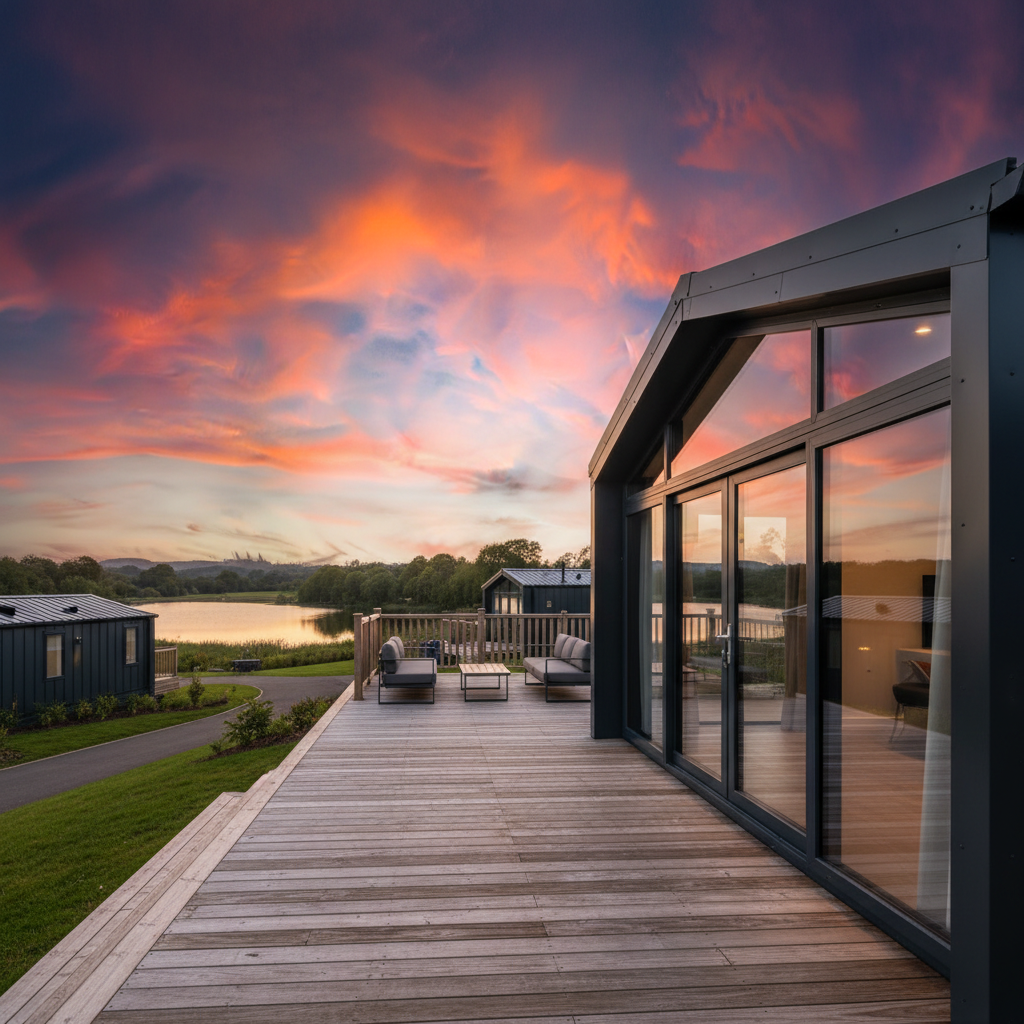
The "box-like" appearance of basic modular units can be completely transformed through external finishes. To meet local planning requirements or to align with a premium park brand, Adacon offers various cladding options, including wood-effect composite and anthracite finishes. This allows the building to blend into natural environments or stand out as a modern, architectural statement. Window and door placement is also fully customisable in the design phase, allowing operators to orientate the building to take advantage of specific site views.
Internally, the standard finish uses 40mm waterproof insulated sandwich panels, which are particularly practical for bathroom walls. For a more residential feel, buyers can opt for upgraded hygiene panels or plaster finishes. The addition of external terraces and decking—quoted separately—can significantly increase the usable "outdoor" footprint of the lodge, creating the indoor-outdoor flow that modern holidaymakers expect from high-end accommodation.
Logistics, Lead Times, and Installation
Speed of deployment is a major advantage of the Adacon system. While bespoke timber lodges can have lead times of six months or more, our typical lead times are measured in weeks. For urgent requirements, "Ready to Order" stock units are often available for even quicker dispatch. We deliver across the UK mainland and Northern Ireland, with transport quoted separately per site and itemised in the final quotation.
Installation is straightforward but requires coordination. The modules are delivered to a level, prepared base, and the customer is responsible for the final electrical connection to a consumer unit and all drainage connections. Each module comes standard with a consumer unit, LED lighting, and power sockets already installed, reducing the amount of on-site trade work required. This "plug-and-play" approach is ideal for expanding school blocks, sports clubhouses, or holiday parks without the prolonged disruption of traditional construction.
Planning Permission and Building Regulations
Navigating the legalities of holiday accommodation requires an understanding of the "Caravan Act" versus permanent modular structures. In many cases, if a modular unit meets the legal definition of a caravan (in terms of size and mobility), it may fall under existing park permissions. However, for permanent installations or changes of use on private land, you must consult your Local Planning Authority (LPA). Adacon provides the technical drawings for the modules, but the planning application process remains the customer's responsibility.
Building Regulations are another key consideration. While private garden rooms may have different requirements, commercial holiday lets must adhere to specific fire safety and insulation standards. The P-series system’s use of non-combustible steel frames and high-performance insulation provides a strong foundation for meeting these regulations. We always advise checking with local authorities to ensure your specific project complies with all regional fire and safety codes for commercial occupancy.
ROI: The Commercial Argument for Modular
From a commercial perspective, the transition to holiday park ROI is driven by two factors: higher nightly rates and lower lifecycle costs. The premium "lodge" branding allowed by a modular build enables operators to charge significantly more than they would for a standard static caravan. Guests are willing to pay a premium for accommodation that feels solid, well-insulated, and modern.
Furthermore, the ability to extend the rental season from a standard 7-month window to a full 12-month calendar dramatically increases the annual yield per plot. Because the steel-framed units do not suffer from the same dampness and structural fatigue as timber units, the replacement cycle is extended. An operator might replace a caravan every 10 years, whereas a modular unit could remain in service for 25 years or more with basic maintenance. This scalability, combined with the ability to add modules as the business grows, makes the Adacon modular system a superior long-term asset for the UK leisure and hospitality sectors.
Design yours online — free
You can lay out a comparisons project yourself in a few minutes with the free Adacon P600 configurator: arrange the modules in 3D, pick your windows, doors and cladding colours wall by wall, and see an estimated price straight away. There is no obligation and no salesperson — save the design and we will pick it up from there.
Prefer to talk it through? Request a free quote and we will come back with a specification and price for your project.
At a glance
| Feature | Static Caravan (Entry-Level) | Adacon Modular Lodge (P-Series) |
|---|---|---|
| Primary Structure | Timber frame on steel chassis | Fully galvanised steel frame |
| Typical Lifespan | 10-15 years | 25+ years |
| Insulation | Basic rockwool/polystyrene | High-density insulated sandwich panels |
| Customisation | Limited to factory models | Fully configurable (Windows, doors, cladding) |
| Occupancy | Seasonal (March-Oct typical) | Year-round (High thermal efficiency) |
| Relocatability | Moderate (Chassis wear) | High (Rigid steel lift points) |
Pros
- • Superior structural integrity for high-traffic rental use
- • Excellent thermal retention for winter bookings
- • Galvanised steel prevents 'chassis rot' common in coastal areas
- • Rapid deployment with lead times often in weeks
- • Instant 3D pricing via the P600 configurator
Cons
- • Higher initial investment than budget caravans
- • Requires a strictly level, prepared base
- • Heavier units may require specialized crane offloading
Frequently asked questions
Written by Adacon
Adacon UK designs, manufactures and delivers bespoke modular buildings across the UK for residential, commercial, education, hospitality, leisure and specialist applications. Buildings are designed around the space and use required: several standard module sizes are available, modules are joined side by side or stacked to form larger buildings, and bespoke configurations are considered where a project needs them — from garden rooms and offices to homes, classrooms, clubhouses, cafés, welfare facilities and two-storey buildings.